
A complete framework for matching mat type to soil, load, duration, and regulatory requirements — built from Select Mat's field experience across energy, pipeline, T&D, and heavy civil projects.
🕒 22 min read 🏗️ Construction Mats · Ground Protection
Construction road mats, also known as temporary roadway mats, ground protection mats, or construction access mats, are a critical component of modern jobsite planning, particularly across heavy civil, energy, and infrastructure projects where ground conditions directly impact safety, productivity, and compliance. When properly selected, these systems stabilize access routes, distribute equipment loads, and protect underlying soil from costly damage or environmental disruption.
Select Mat has spent years supporting contractors across energy, utility transmission & distribution, pipeline, heavy civil, industrial construction, renewable energy, and emergency response. That operational experience is the foundation of every recommendation in this guide.
Effective mat selection depends on four variables: soil type, equipment load, project duration, and regulatory environment. This guide walks through each factor in detail, compares material types, and provides a structured framework for choosing the right solution from the first site walkthrough through final demobilization.
Unstable ground conditions are one of the most preventable sources of project delays and cost overruns in heavy construction. When equipment begins to sink or rut, the consequences compound quickly: access routes close, crews stand idle, remediation crews mobilize at premium rates, and regulatory inspectors take notice.
Every contractor working in drainage-sensitive areas knows the pain of an unexpected shutdown. Projects built on soils with low bearing capacity often face remediation costs that significantly exceed the upfront investment in proper matting, making surface stabilization one of the highest-ROI decisions a project manager can make before first mobilization.
Construction road mats address this exposure by creating a stable working surface that prevents rutting, minimizes soil displacement, and maintains consistent site access in all weather conditions. For projects operating on sensitive terrain — wetlands, tidal zones, agricultural fields, and permafrost corridors — they also serve as the primary tool for demonstrating environmental good faith to regulators and landowners.
Failing to stabilize access routes in regulated areas can trigger project suspensions, consent orders, and third-party remediation requirements. Build your mat plan before you build anything else.
Heavy machinery exerts point loads on soil surfaces that the ground was never designed to absorb. A crane rig, pipeline spread, or directional drill can impose 100,000 lbs or more through a single outrigger float, concentrating force on an area smaller than a dining table.
Properly engineered mat systems distribute that weight evenly, reducing point-load stress and eliminating the instability that leads to crane tip-overs and equipment damage. Federal crane safety standards require ground conditions to be firm, drained, and stable enough to support the crane’s imposed loads under all operating configurations.
The ASME B30.5 standard for mobile and locomotive cranes specifies that outrigger blocking must prevent settling, shifting, and structural failure under load — requirements that mat systems are specifically engineered to satisfy.
Understanding load class requirements is critical when selecting mats, particularly when operating across variable terrain or soft soils. A mat that performs well under a tracked excavator may fail under the concentrated float load of a crawler crane in the same conditions.
Selecting the right mat begins with understanding the available material types and their performance characteristics. Not all mats are created equal, and in demanding applications, choosing the wrong type can cost more than choosing no mat at all.
Every mat type has an appropriate application. The right solution depends on ground conditions, load requirements, project duration, logistics, and overall project economics. The comparisons below are designed to help you match the right mat to your specific conditions.
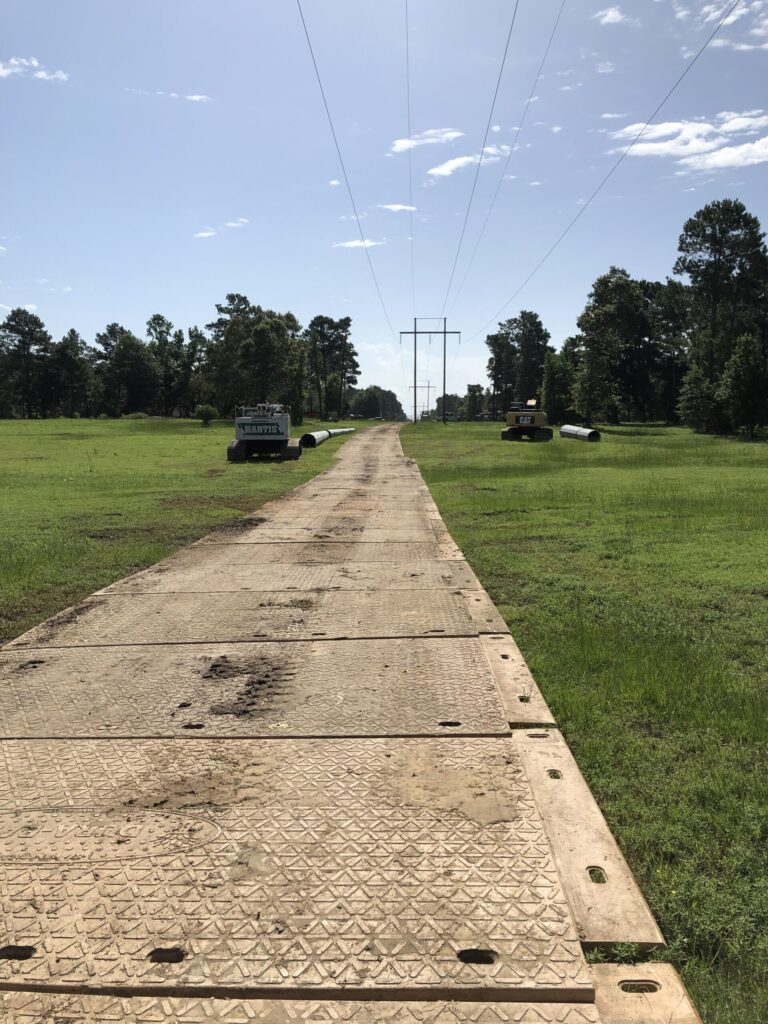
Composite mats are one of Select Mat’s core solutions, and for heavy civil, energy, and infrastructure projects with demanding load, chemical-exposure, or reuse requirements, they consistently perform well across a wide range of conditions. Engineered from high-density polyethylene (HDPE) and thermoplastic blends, they are purpose-built for the demands of modern jobsites.
Composite mats typically outperform wood-based alternatives in many demanding applications. They are Select Mat’s recommended solution where these advantages matter most:
Lighter per-unit weight means more mats per truckload, reducing transportation cost on large deployments.
Performs consistently from -40°F to 140°F without brittleness, softening, or structural fatigue.
Composite mats are designed for repeated deployment across many projects over many years.
Does not degrade in contact with fuel, hydraulic fluid, brine, or saltwater, unlike any wood-based alternative.
Composite has real tradeoffs too: the upfront investment is higher than wood-based alternatives, and while most impact damage is repairable, severe damage may not be, at which point the mat needs replacing rather than repair.
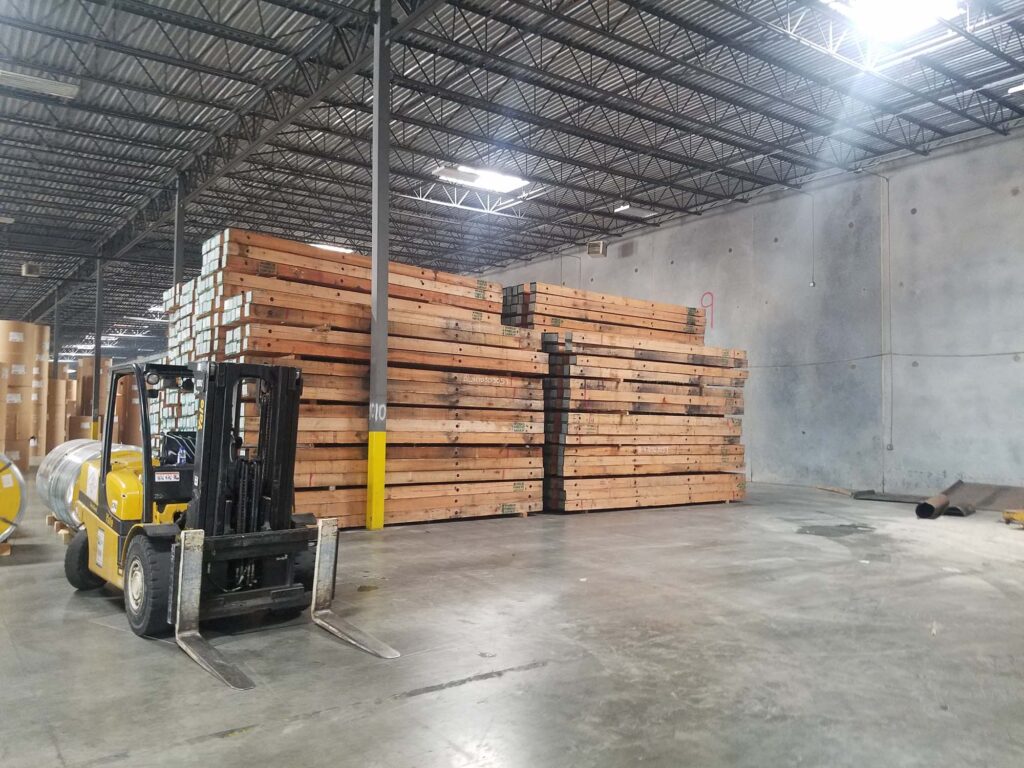
Timber mats are a traditional ground protection solution commonly used where cost and immediate availability are the primary decision factors. They provide a stable working surface for equipment and access routes, particularly in short-term or lower-demand applications.
Timber’s strengths are practical: it is a familiar, widely available material that most crews already know how to procure, deploy, and repair in the field, and damaged mats can often be fixed on site rather than replaced. On stable, level ground and shorter-duration projects, timber remains a straightforward, cost-effective choice. Because it’s widely stocked by local suppliers, timber is also often the easiest mat type to source quickly on emergency response jobs, where speed of availability matters more than long-term performance.
Project managers choosing timber mats should also plan for the following limitations:

Cross-laminated timber (CLT) mats are an engineered alternative to traditional timber mats. By layering wood panels in alternating directions, CLT achieves better structural consistency and more predictable load distribution than sawn lumber.
CLT mats fill a niche between traditional timber mats and advanced composite systems — a solid fit for projects where a fully engineered synthetic system is not required. The material remains wood, and wood degrades over time and with repeated exposure, a factor worth weighing against your project’s duration and reuse needs.
Where CLT is appropriate:
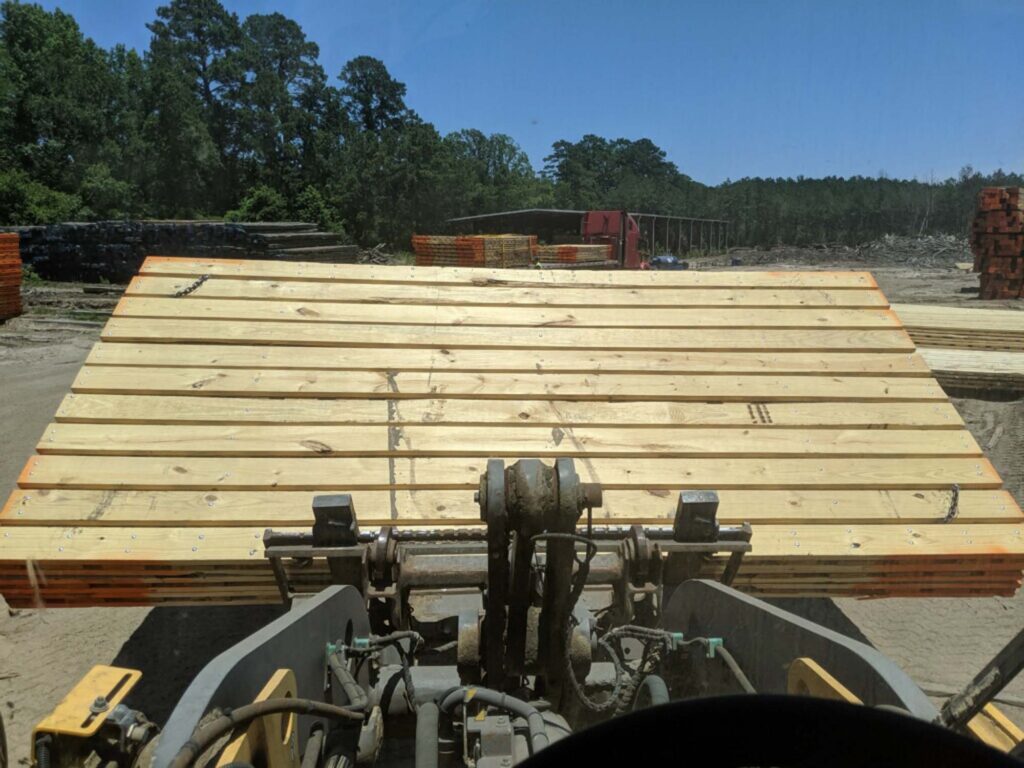
Laminated mats are a practical middle-ground solution for temporary access, staging areas, and general construction traffic. Constructed from multiple layers of lumber fastened together, they create a solid surface that supports equipment movement while maintaining site accessibility in varying ground conditions.

Crane mats are built for extreme load-bearing conditions, providing the structural support needed anywhere concentrated point loads meet the ground. They’re sometimes called crane support mats or work platform mats.

Access mats create temporary roads and work surfaces across soft, uneven, or environmentally sensitive terrain, prioritizing mobility and ground protection across larger surface areas. These systems are also referred to as temporary access roads, access road mats, or heavy equipment mats.
These systems are commonly deployed together: access mats establish the pathways; crane mats reinforce specific load zones where stability is mission-critical.
| Mat Type | Best Application | Load Capacity | Weather Resistance | Reusability | Best For |
|---|---|---|---|---|---|
| Composite | High load, long duration, chemical exposure | Very High | Excellent | Very High | Long-term, energy, heavy civil |
| Crane Mats | Heavy lifts, rig floors | Very High | Good | High | Crane pads, drill sites |
| Timber | Short-term access | Moderate | Fair | Moderate | Budget-sensitive, temp projects |
| Laminated | Light traffic, staging | Light–Medium | Fair | Moderate | Temp roads, staging areas |
| CLT | Spec-driven projects | Moderate | Fair | Low–Moderate | Engineered wood requirements |
| Access Mats | Temp roads, soft terrain | Moderate–High | Good | High | Pipeline, T&D, site access |
A pipeline contractor operating in saturated soil conditions across Southeast Texas deploys heavy equipment across fourteen access points simultaneously. Without proper matting, equipment begins to sink into clay-heavy soils within 72 hours of first mobilization. The contractor faces a choice: halt operations and remediate, or deploy the right mat system from the start.
By implementing a combination of composite access mats along travel corridors and heavy crane mats at each equipment staging area, the contractor stabilizes ground conditions across all access points. Project timelines hold, environmental monitors clear the site for continued work, and post-project restoration costs drop to near zero compared to the previous year’s unmatted deployment on a similar soil profile.
Soil composition directly determines how weight distributes under a mat system. The same mat that performs flawlessly on gravel may fail catastrophically on saturated clay. Understanding your soil profile before mobilization is not optional — it is the first step in any responsible mat selection process.
How long mats will be deployed, and how frequently they will be moved, is as important as what they will support. The right procurement model changes significantly based on project duration:
Select Mat supports fleet lifecycle management through programs that help clients sell used access mats and recover project value rather than absorbing storage and maintenance costs indefinitely.
Environmental compliance is not a secondary consideration in construction planning — it is a project-critical constraint that mat selection must address directly. In areas where ground disturbance must be carefully controlled, choosing the wrong access strategy can trigger regulatory action that halts operations entirely.
Projects that disturb soil within regulated wetland boundaries must obtain individual permits that can take six to twelve months to secure, a timeline that makes early mat planning essential. The U.S. Army Corps of Engineers Section 404 permitting process requires applicants to demonstrate that impacts to waters of the United States have been avoided and minimized to the greatest extent practicable before a permit will be issued.
Reusable mat systems reduce material waste, limit site restoration needs, and support long-term project efficiency. Selecting the right mat from the start is the most effective way to demonstrate regulatory good faith and protect project timelines.
Construction road mats are not a one-size-fits-all product. Deployment strategy, mat type, and procurement model vary significantly by industry. The following sections cover vertical-specific tactics for the sectors where Select Mat has the deepest operational experience.
Oil and gas projects operate in some of the most demanding ground conditions in the country — remote locations, saturated soils, tight permit windows, and equipment loads that exceed 100,000 lbs on a single outrigger. Mat strategy on an oil and gas site is a production tool, not an afterthought.
Pipeline spreads cover more linear ground per day than almost any other construction operation, and they do it continuously, often through soil conditions that change with every mile. Mat management on a pipeline right-of-way is a logistics operation as much as a ground protection operation.
Transmission and distribution projects combine the linear access challenges of pipeline work with the pinpoint-precision load demands of tower and substation construction. T&D rights-of-way frequently cross the most environmentally sensitive areas in a project corridor.
Heavy civil projects — highways, bridges, water infrastructure, industrial facilities, ports, marine terminals, and industrial waterfronts — combine the sustained high-traffic demands of a permanent construction site with the ground-protection challenges of undeveloped land.
Renewable energy projects require reliable ground stabilization throughout every phase of development, from initial site preparation and access road construction to equipment installation and ongoing maintenance. Select Mat supports solar, wind, and battery storage projects by providing durable, reusable mat systems designed for remote locations, challenging terrain, and heavy equipment operations.
Industrial construction projects — petrochemical, refining, LNG, steel mills, paper mills, chemical plants, and manufacturing facilities — present some of the most demanding ground and chemical-exposure conditions Select Mat serves.
Disaster response and emergency access projects require rapid deployment of stable ground surfaces, often with little advance planning time.
Choosing the right mat system requires balancing several factors, as no single mat type performs best in every situation. Weight, flexibility, weather resistance, reusability, sustainability, and cost can vary significantly between materials. The best choice depends on your project’s ground conditions, equipment requirements, and expected duration. The table below compares composite, timber, CLT, laminated, and crane mats across the key factors that influence mat selection.
| Attribute | Composite | Timber | CLT | Laminated | Crane Mats |
|---|---|---|---|---|---|
| Best Use | Long-term, high-demand projects | General construction & access | Engineered wood applications | Temporary access & staging | Heavy lifting & outrigger support |
| Load Capacity | High | High | Moderate | Moderate | Very High |
| Weight | Medium | Heavy | Medium | Medium | Very Heavy |
| Weather Resistance | Excellent | Good | Good | Fair–Good | Good |
| Chemical Resistance | Excellent | Poor | Poor | Poor | Fair |
| Repairability | Moderate | Excellent | Moderate | Good | Excellent |
| Expected Reuse | Very High | High | Moderate | Moderate | Very High |
| Freight Efficiency | Excellent | Fair | Good | Good | Poor |
| Environmental Performance | Recyclable | Renewable | Renewable | Renewable | Renewable |
| Typical Upfront Cost | High | Medium | Medium | Low–Medium | High |
| Lifecycle Cost | Excellent | Good | Moderate | Moderate | Good |
| Equipment Type | Typical Load Range | Recommended Mat Type |
|---|---|---|
| Light Vehicles (Pickup trucks, UTVs) | ~5,000–8,000 lbs | Laminated or light-duty mats |
| Medium Equipment (Excavators, loaders) | 30,000–80,000 lbs | Timber or composite mats |
| Heavy Equipment (Cranes, drill rigs) | 100,000+ lbs | Crane mats or heavy composite mats |
Sustainability is another area where the “best” choice depends on the priorities of the project. Timber offers a natural carbon-storage benefit because the wood retains carbon captured during tree growth, provided it is not burned at the end of its useful life. Composite mats, often made from recycled HDPE, can be recycled again after use, though their petroleum-based origins mean they do not provide the same carbon-sequestration benefit as timber. CLT, produced from fast-growth pine, offers another sustainable option by combining renewable sourcing with engineered strength and durability. Ultimately, the right material depends on your project’s environmental goals, lifecycle considerations, and disposal plan, along with its performance requirements.
Environmental conditions play a major role in mat performance, as temperature, moisture, and site chemistry can affect how each material responds under load and over time. Composite mats perform well in a wide range of conditions, though extreme cold can make them more brittle and may cause locking pins to freeze during disassembly. Wood-based systems are more vulnerable to prolonged moisture exposure, but timber and crane mats continue to provide reliable performance in cold environments and high-load applications.
| Condition | Ground Impact | Mat Performance Consideration | Recommended Mat Type |
|---|---|---|---|
| Wet / Saturated | Reduced bearing capacity, high rutting risk | Requires mats that distribute weight and maintain traction | Composite, access mats |
| Clay (Wet) | Soft and unstable under load | High load distribution to prevent deformation | Composite, crane mats |
| Sandy Soil | Shifts under pressure | Stabilization to prevent displacement | Composite, access mats |
| Gravel / Firm Ground | Stable, prone to surface wear | Lighter reinforcement for repeated traffic | Laminated, timber mats |
| Extreme Heat | Softening of temperature-sensitive materials | Requires temperature-stable material | Composite mats |
| Freezing Conditions | Composite can become brittle and locking pins may freeze; wood mats gain some rigidity in hard-frozen ground | Reliable disassembly and structural integrity in sustained cold | Heavy-duty timber, crane mats |
| Oil & Gas Environments | Chemical, oil, and brine exposure | Requires chemical resistance and traction | Composite, crane mats |
Efficient logistics and proper handling practices play a critical role in maximizing the performance and lifespan of construction mats. From transportation planning to onsite maintenance, each step impacts project timelines, safety, and overall cost efficiency.
See also: How Construction Mats Enhance Worker Confidence on Project Sites. Select Mat also provides professional Installation and Removal services for projects where managed deployment is part of the mat solution.
Understanding the true cost of construction mats requires looking beyond unit pricing and evaluating how each option performs over the full lifecycle of a project. The right procurement model depends on deployment duration, frequency of reuse, and long-term operational goals.
| Option | Best For | Key Advantages | Considerations |
|---|---|---|---|
| Rental | Short-term projects, temp access | Lower upfront cost, flexible deployment, no long-term commitment | Limited availability for extended use; recurring rental costs add up on projects over 60 days |
| Leasing | Medium to long-term, evolving timelines | Spreads cost over time; access to higher-quality mats without full purchase | Ongoing payments; does not build ownership equity or residual fleet value |
| Purchase | Long-term or multi-project use | Full ownership, maximum reuse potential, strongest long-term ROI | Higher upfront investment; requires dedicated storage, maintenance, and fleet management planning |
For a complete breakdown of cost structures across all three models, Access or Temporary Road Mat Rental vs Leasing: Complete Cost Comparison Guide 2025 covers per-project total cost analysis, break-even calculations, and fleet sizing recommendations. To explore rental and lease programs directly, visit the Rent or Lease page.
The lowest-cost mat system is not always the one with the lowest rental rate. Transportation, handling, and project duration can significantly impact the final cost of a matting solution. Composite mats offer a major logistics advantage because their lighter weight allows more coverage per truckload, reducing freight costs, fuel consumption, and installation time. In contrast, hardwood mats may become heavier during use as they absorb moisture and soil, potentially increasing removal and transportation costs.
That said, freight savings do not tell the whole story. Composite mats generally come with a higher rental rate, while hardwood or laminated mats may provide cost advantages on longer projects where lower daily rates outweigh additional logistics considerations. The best choice depends on the full project picture, including duration, site conditions, maintenance needs, and transportation requirements.
The true value of construction mats extends beyond initial cost and is measured through cost avoidance, operational efficiency, and fleet residual value. The three biggest drivers of mat ROI:
Example: mat investment cost = $100,000. Avoided restoration = $150,000. Avoided downtime = $75,000.
ROI = ($225,000 total benefits − $100,000 cost) / $100,000 cost = 125%.
Everything above is about choosing the right mat. Just as important is choosing the right supplier — one who can actually deliver that mat plan at the scale and speed your project demands.
Select Mat combines national inventory and logistics capacity with the responsiveness and field experience contractors need to keep a project on schedule:
Select Mat brings together the resources and capabilities of a national-scale supplier with the responsiveness and operational knowledge of a team that has been in the field on projects like yours. Every customer, regardless of project size, receives direct attention and a commitment to getting the mat solution right.
These capabilities are what turn a mat selection framework into a working solution on your site. Call (800) SELECT-MAT to put them to work on your next project.
The following questions represent the most common decision points project managers, procurement officers, and field superintendents encounter when evaluating construction road mat options. For additional questions, visit the Select Mat FAQ page.
Soil type, equipment load, project duration, and environmental conditions are the four primary variables. A project manager working in saturated clay with 100,000-lb crane loads has a different answer than one building a temporary haul road across firm gravel for light vehicle traffic. Work through each factor before selecting a material or procurement model.
Yes. Many projects require a combination of mat types to address varying ground conditions, equipment loads, and operational needs. Select Mat frequently designs customized matting solutions that combine access mats, crane mats, and specialty systems throughout a single project. For example, a site may use heavy-duty access mats for haul roads and equipment travel paths while using higher-capacity crane mats in areas with concentrated loads from cranes, excavators, or other heavy equipment. By matching the right mat system to each area of the project, Select Mat helps customers achieve the right balance of performance, safety, and cost efficiency.
Composite mats typically outperform timber mats across most long-term metrics, including structural durability, weather resistance, reusability, and chemical resistance. Timber mats carry a lower upfront cost but higher replacement frequency. On projects exceeding 90 days or involving redeployment across multiple sites, composite systems typically reach cost parity and outperform on total cost of ownership.
CLT mats use cross-laminated panels that provide better stiffness and more consistent load distribution than standard sawn lumber. However, both are wood-based and share the same moisture vulnerability. CLT fills a niche between traditional timber and advanced composite systems — a good fit for projects where fully engineered synthetic systems are not required.
In most cases, yes — not just recommended. Federal crane safety regulations mandate that ground must be firm, stable, and capable of supporting imposed loads. In practice, this means crane mat systems are required any time ground conditions cannot be independently verified to meet the crane’s outrigger load requirements. Your crane operator and rigging supervisor will expect mats on soft, wet, or unverified ground conditions.
For access routes, multiply route length by route width and divide by the mat size to estimate total coverage. Add 10–15% for overlap, transitions, and turning areas. For crane pads and equipment staging areas, calculate the footprint of each piece of equipment at full outrigger extension plus a 3-foot setback on each side. Select Mat can assist with deployment planning on larger projects — call (800) SELECT-MAT.
Heavy-duty composite access mats and crane mats provide strong stability and traction in saturated or unstable soils. Their non-porous construction means they do not absorb water and lose structural integrity the way timber systems do. For the most challenging conditions — tidal wetlands, spring thaw, or active precipitation — composite systems are typically the most reliable choice.
Yes, when properly selected and deployed. Matted access routes protect soil structure, prevent sediment disturbance, and reduce the footprint of equipment traffic on vegetation and topsoil. In wetland-adjacent areas, mats used in combination with silt fence and turbidity monitoring provide documented evidence of environmental stewardship that regulators expect to see during permit compliance inspections.
Yes. Rental options are available for daily, weekly, or monthly deployments. Rental is most cost-effective for projects under 30–45 days where mat reuse across future projects is not part of the plan. For longer projects, leasing or purchase typically delivers better economics.
Mats are cleaned to remove soil, debris, vegetation, and chemical residue before redeployment. Cross-site contamination protocols are particularly important when moving mats from industrial sites to agricultural easements or environmentally sensitive corridors. Select Mat’s cleaning procedures satisfy most environmental compliance requirements for mat reuse across regulated sites.
Yes. A properly designed mat deployment uses access mats along travel corridors and crane mats at specific load points — the two systems work together. For pipeline spreads, this means access mats advance with the spread across the right-of-way while crane mats stage at tie-in locations, water crossings, and horizontal directional drilling entry points where concentrated loads occur.
The Select Mat team has supported mat planning on projects from single-well pads to multi-state pipeline corridors. If your question is not answered here, call (800) SELECT-MAT or visit selectmat.com/faqs/ for the complete FAQ library.
Selecting the right construction road mats directly impacts project safety, efficiency, and long-term cost. The decisions made before first mobilization — mat type, procurement model, deployment coverage — determine whether your project stays on schedule or absorbs preventable costs in remediation and downtime.
Match mat type to soil conditions and equipment load class — the same mat does not perform the same way on clay, sand, gravel, and organic soils
Composite mats typically deliver the strongest ROI in demanding, high-reuse applications. Timber, laminated, and CLT remain the right call for shorter-term or budget-driven projects
CLT mats improve on standard timber but are not a substitute for engineered composite systems in high-load or extended-deployment scenarios
Crane operations require certified ground support — mat selection at lift points is a safety and compliance issue, not just an access issue
Environmental and regulatory compliance begins with your mat plan — protect your permit, your schedule, and your landowner relationships by getting the mat deployment right from the start
Industry context drives strategy — oil & gas, pipeline, T&D, and heavy civil each require different deployment approaches, mat types, and logistics models
Total cost of ownership, not upfront price, is the right framework for evaluating any mat procurement decision
Choosing the right construction road mats requires a clear understanding of your project conditions, equipment demands, and long-term operational goals. Select Mat provides engineered solutions designed for heavy civil, infrastructure, and energy applications nationwide, from single-location rental deployments to multi-year fleet programs.
Rather than a one-size-fits-all recommendation, your mat selection should be driven by how your site conditions, load requirements, and deployment duration align with each solution:
Durable, reusable systems engineered for long-term performance, high-traffic environments, and chemical-active sites
Cost-effective solutions for short-term access and lighter-duty applications where upfront cost is the primary consideration
Engineered timber systems with improved load distribution over standard timber; best for spec-driven applications with limited reuse needs
Practical solutions for temporary access roads and staging areas supporting general construction traffic
Heavy-duty systems engineered to support extreme loads and stabilize lifting operations at critical load points
Versatile ground protection solutions that maintain mobility across soft, uneven, or environmentally sensitive terrain
Whether you are building temporary access roads, stabilizing a wellpad, supporting a pipeline spread, or protecting an environmentally sensitive corridor, Select Mat helps you identify the most effective solution for your project and backs it up with the logistics capacity to deliver it on your timeline.
Browse the full Select Mat product catalog, explore the full range of Services, or request a customer quote today to get expert guidance tailored to your site conditions.