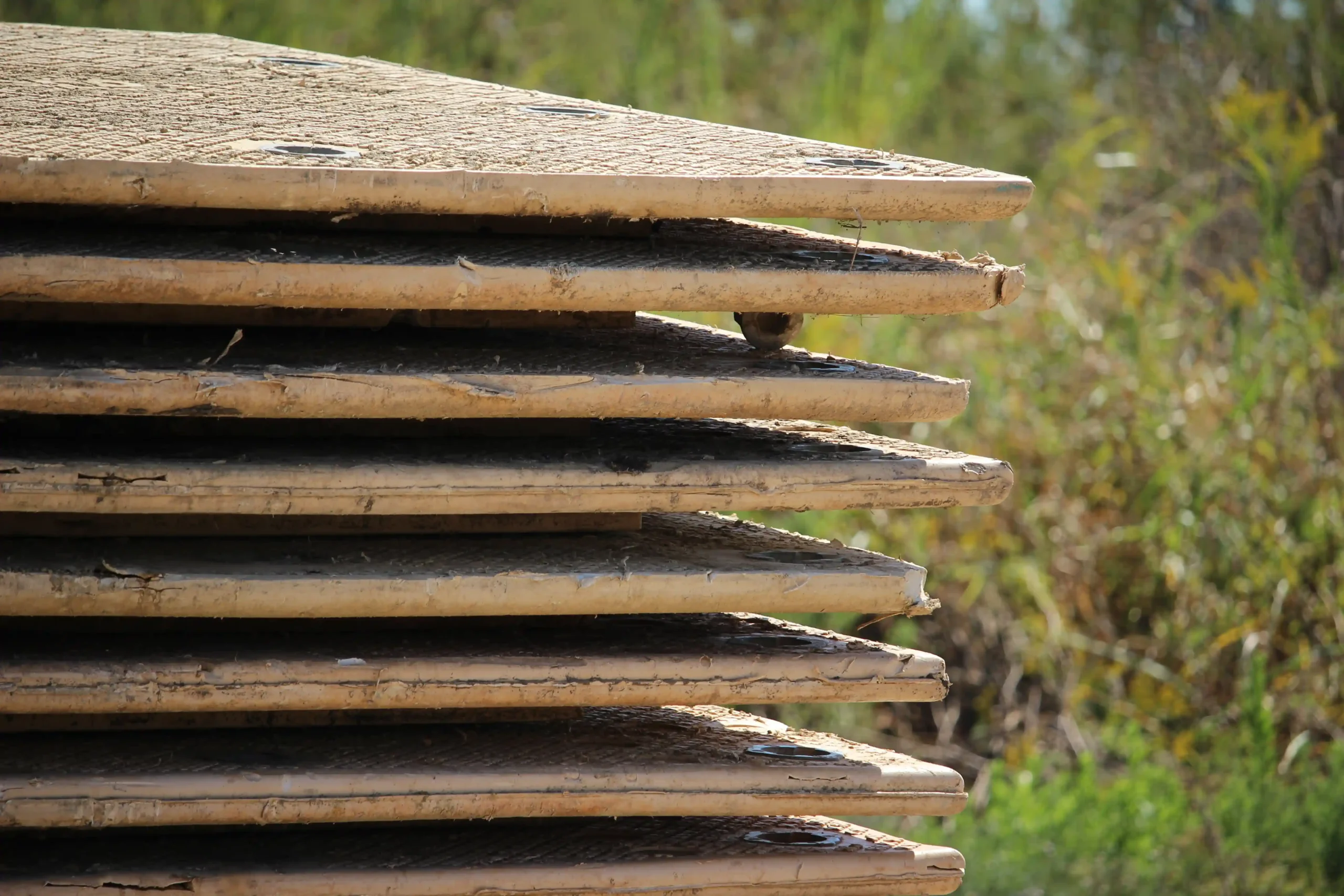
Composite mats solve real problems, but they aren’t perfect — know the load limits, hydrocarbon slip risk, and hidden subsidence before you rely on them.
This is a companion piece to our parent guide, Hardwood Laminated Mats vs. Composite Mats: How to Choose the Right Access Mat for Your Project.
Choosing the right mat for a construction or access project involves more than comparing materials. Our ultimate guide to choosing construction road mats covers the key factors to consider when evaluating mat types, load requirements, site conditions, and project needs.
Key Findings
- Not all composite mats carry the same load. Ratings vary by product, so verify the rating and match it to the actual equipment before deployment.
- A mat can’t exceed the ground beneath it. Mats spread load to lower contact pressure, but the soil’s bearing capacity still sets the ceiling — soft, wet soil supports far less than firm, compacted ground. [1]
- Hydrocarbons create a slip hazard. Fuel and oil on any hard surface reduce traction, so spill kits, containment, and cleanup protocols are required — and above certain storage volumes, an EPA spill plan is a legal obligation. [4][5]
- A continuous surface can hide what’s underneath. Voids can grow below ground while the surface stays intact, until support fails suddenly — the same mechanism behind sinkhole collapse. [2][3]
- Detection is manual and routine: inspect edges, watch for deflection, and probe the ground when conditions warrant. A smooth top is not proof of solid support.
Bottom line: Composite mats are a strong system used correctly. The risks come from assuming the surface tells you everything about the ground.
Load capacity: verify the rating, then check the ground
Composite mats are not interchangeable. Load ratings vary between products, so the first step is always to verify the published rating and match it to the equipment that will actually cross it — including the heaviest single machine and its outrigger or track loading, not just typical traffic.
The step teams skip is the second one: the ground. A mat works by distributing weight across a larger area, which lowers the contact pressure the soil sees. But bearing capacity — the maximum pressure soil can take before it fails in shear — is a property of the soil, not the mat. [1] Soft, saturated ground supports dramatically less than firm, compacted ground, so the same mat performs very differently on two sites. If the ground pressure under load still exceeds what the soil can carry, the mat won’t save you; on demanding lifts and heavy static loads, that’s a question for a geotechnical assessment, not a spec sheet.
Two rules follow: verify ratings against real equipment, and confirm the ground can support the resulting pressure.
Slip risk: hydrocarbons on a hard surface
Oil and fuel on a composite surface create a genuine slip hazard. HDPE is non-porous, which is an advantage for cleaning and contamination but means spilled hydrocarbons sit on top rather than soaking in — and a slick film on a hard surface reduces traction underfoot and under tires.
The controls are procedural, and partly regulatory. OSHA requires walking and working surfaces to be kept clean, orderly, and free of hazards, which puts prompt cleanup squarely in scope. [6] On the environmental side, EPA’s Spill Prevention, Control, and Countermeasure (SPCC) rule applies to facilities that store, use, or transfer oil above a threshold aboveground capacity — commonly cited at more than 1,320 gallons — and calls for spill planning and secondary containment. [4] Standard practice is to keep spill kits staged near oil-bearing containers and equipment, store containers with secondary containment away from traffic paths, and clean spills immediately rather than at end of shift. [5]
Subsidence: the risk you can’t see
This is the most underestimated limitation. A continuous composite surface spans and bridges soft spots — which is exactly what you want it to do, and also what makes it possible for a problem to develop unseen. Ground can be softening, eroding, or voiding beneath a surface that still looks and feels solid.
The geology explains why this matters. Land subsidence is the gradual settling or sudden sinking of the ground caused by subsurface movement of earth materials, and voids can develop underground while the land surface remains intact — until the void grows large enough that support fails and collapse happens suddenly. [2][3] A mat that bridges a developing void can delay the visible symptom without changing the underlying condition.
Detection has to be deliberate, because the surface won’t volunteer the information. Inspect mat edges and transitions where movement shows first, watch for deflection or springiness under load, note standing water and drainage changes that signal erosion below, and probe the ground where conditions or history warrant. Treat a smooth surface as a reason to check, not a reason to relax.
Quick reference: limitation, risk, and control
| Limitation | What can go wrong | Control |
|---|---|---|
| Load rating varies by product | Mat overloaded by heavier equipment than rated | Verify published rating; match to heaviest actual machine |
| Soil bearing capacity | Ground fails even if the mat holds [1] | Assess soil; geotechnical review for heavy or static loads |
| Hydrocarbon slip risk | Reduced traction for workers and vehicles | Spill kits, containment, immediate cleanup; SPCC plan where required [4][5][6] |
| Subsidence masking | Voids grow unseen; sudden loss of support [2][3] | Edge inspection, deflection checks, ground probing |
Action plan: use composite mats safely
- Verify the load rating for the specific product against the heaviest equipment and its loading pattern — not average traffic.
- Assess the ground, not just the mat. Confirm the soil can carry the resulting pressure; get a geotechnical opinion for heavy or static loads. [1]
- Stage spill response before mobilization. Position spill kits near oil-bearing equipment and containers, with secondary containment. [5]
- Confirm your SPCC obligations. If oil storage exceeds the regulatory threshold, a spill plan is required, not optional. [4]
- Clean spills immediately and keep surfaces clear to control slip risk. [6]
- Inspect edges and probe the ground on a set schedule, and after heavy rain or a change in drainage.
FAQ
What are the main limitations of composite mats?
Three matter most: load ratings vary by product and must be matched to actual equipment; hydrocarbons like fuel and oil create a slip hazard on the non-porous surface; and a continuous surface can bridge weak ground and mask developing subsidence or voids underneath. [2][3] All three are manageable with verification, spill protocols, and routine ground inspection.
Do all composite mats have the same load capacity?
No. Ratings vary between products, so you have to verify the published rating and match it to the heaviest machine and loading pattern that will actually use the surface. Just as important, the soil’s bearing capacity sets an independent ceiling — a mat spreads load, but it can’t make weak ground stronger. [1]
Why are composite mats slippery when oil spills on them?
Because HDPE is non-porous, spilled fuel or oil sits on the surface instead of absorbing in, leaving a slick film that reduces traction. The controls are spill kits staged near oil-bearing equipment, secondary containment, and immediate cleanup — OSHA requires walking and working surfaces to be kept clean and free of hazards. [5][6]
Do I need a spill plan when using composite mats?
It depends on your oil storage, not the mats themselves. EPA’s SPCC rule applies to sites that store, use, or transfer oil above a threshold aboveground capacity — commonly cited at more than 1,320 gallons — and requires spill planning and containment measures. [4] Confirm your site’s storage volume and applicable requirements before mobilizing.
How can composite mats hide ground problems?
A continuous surface bridges soft spots, so the top can look and feel solid while the ground beneath softens, erodes, or voids. That’s the same pattern behind sudden ground collapse: voids grow underground while the surface stays intact until support fails. [2][3] The mat doesn’t cause the problem, but it can delay the visible warning.
How do I detect subsidence under a composite mat surface?
Manually and routinely. Inspect mat edges and transitions where movement appears first, watch for deflection or springiness under load, track standing water and drainage changes that suggest erosion below, and probe the ground where site history or conditions warrant — especially after heavy rain.
Sources
- Bearing Capacity (maximum contact pressure soil can support before shear failure) — Wikipedia
- Karst, Sinkholes, and Land Subsidence — U.S. Geological Survey
- What Is the Difference Between a Sinkhole and Land Subsidence? — U.S. Geological Survey
- Overview of the Spill Prevention, Control, and Countermeasure (SPCC) Regulation — U.S. EPA
- Best Management Practices: Spill Prevention and Control Measures — U.S. EPA
- Walking-Working Surfaces (keep surfaces clean, orderly, and free of hazards) — OSHA