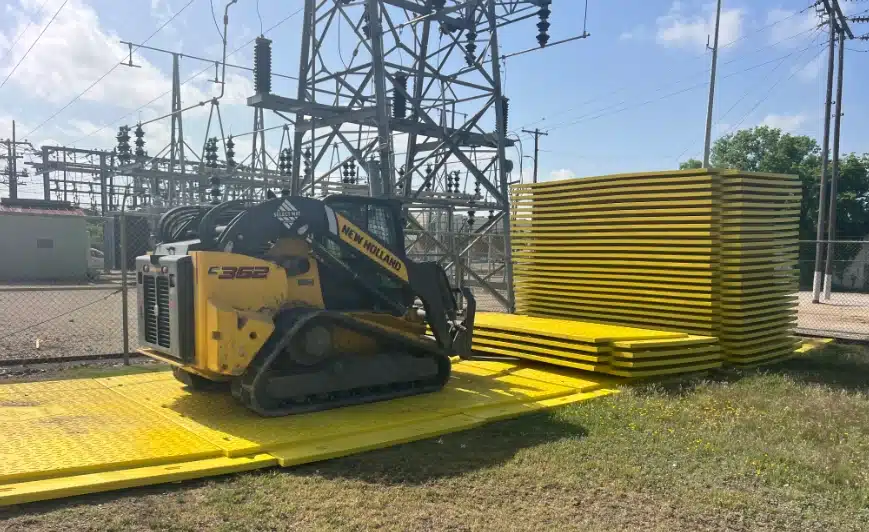
Quick Answer: CLT mats (Cross-Laminated Timber mats) are engineered wood construction mats made from 3-5 layers of softwood pine lumber glued perpendicular to each other. They’re designed for rubber-tired vehicles on pipeline MRO projects, transmission and distribution (T&D), and construction sites, offering up to 40% weight savings compared to traditional laminated hardwood mats while maintaining exceptional strength.
Construction projects rarely happen on smooth ground. Often jobs end up in the middle of swamps or areas that are wet and unstable. Road matting creates access in these challenging locations so you can move your equipment through areas on your job site where they’d otherwise get stuck.
But which road mat options are best for your site’s needs?
This complete guide covers CLT mats—a commonly used engineered wood mat that can help you cover a lot of ground efficiently. Whether you’re managing pipeline work, T&D infrastructure, or heavy construction in rough terrain, understanding CLT mats will help you make smarter equipment decisions.
What Are Cross-Laminated Timber Construction Mats?
CLT mats are engineered construction mats made by using multiple layers of pine lumber, with each layer laid perpendicular to the last. The layers are glued together using hydraulic or vacuum pressure to create a unified, rigid mat.
This cross-lamination process provides exceptional strength and rigidity that allows the mat to support significant weight in demanding applications. Think of engineered wood beams used in building construction.
Where CLT Mats Are Used
You’ll find CLT mats being used across:
- Oil & Gas – Well pad access, drilling operations, pipeline ROW access
- Transmission & Distribution (T&D) – Utility line installation, maintenance access
- Heavy Construction – Sites requiring equipment access over unstable ground
- Pipeline Projects – Temporary roads for welding, hauling, and inspection equipment
- Renewable Energy – Wind and solar farm construction access
These industries regularly operate heavy-duty equipment in rough, unstable terrain where traditional ground conditions would cause vehicles to sink or get stuck.
3-Layer vs 5-Layer CLT Mats: What’s the Difference?
Understanding the distinction between 3-layer and 5-layer CLT mats is critical for equipment safety and mat longevity.
3-Layer CLT Mats (Standard)
Construction: Three layers of pine lumber glued perpendicular to each other
Best For: Rubber-tired vehicles only
Weight: Up to 40% lighter than 3-ply hardwood laminated mats
Applications:
- Service trucks and utility vehicles
- Temporary access using light equipment with rubber tires or light weight rubber tracked equipment
- Projects prioritizing weight savings and freight efficiency
⚠️ Important: Standard 3-layer CLT mats should NOT be used with steel tracked equipment. The thinner profile cannot withstand the concentrated pressure from continuous tracks. These mats will splinter and/or delaminate the layered plies.
5-Layer CLT Mats (Heavy-Duty)
Construction: Five layers of pine lumber for increased thickness and strength
Best For: Both rubber-tired vehicles AND some steel tracked machinery
Weight: Heavier than 3-ply CLTs, but still lighter than hardwood timber mats
Applications:
- Small excavators and some bull dozers
- Mixed equipment sites
- Heavy-duty construction requiring versatile matting
✓ Advantage: The additional layers provide the structural integrity needed to handle the point-loading stress from tracked equipment.
CLT Mats vs Other Construction Mat Types
| Feature | CLT Mats | Laminated Mats | Composite Mats | Timber Mats | Crane Mats |
| Layers/Construction | 3-5 layers, glued perpendicular | 3 layers, bolted/nailed | HDPE plastic | Solid hardwood, 8” thick bolted | Solid hardwood, 12″ thick |
| Weight | Lightweight | Medium | Medium | Heavy | Very Heavy |
| Rubber-Tired | ✓ (All) | ✓ | ✓ | ✓ | ✓ |
| Tracked Equipment | ✓ (limited use with 5-layer) | ✗ | ✓ | ✓ | ✓ |
| Flexibility | Low (rigid wood) | Medium | High | Low | Low |
| Weather Resistance | Good | Good | Excellent | Excellent | Excellent |
| Reusability | High | Medium-High | Very High | Very High | Very High |
| Freight Efficiency | Excellent (40% lighter) | Good | Excellent | Poor (heavy) | Poor (very heavy) |
| Sustainability | Excellent (fast-growth pine) | Good | Good (recyclable) | Medium | Medium |
| Cost Range | Medium | Low-Medium | Medium-High | Medium-High | High |

Engineered Wood Technology: What Makes CLT Mats Different
CLT mats utilize engineered wood product technology rather than traditional hardwood lumber boards to enhance their performance characteristics.
Material Composition
Primary Wood Species: Softwood species like loblolly pine
Why Pine?
- Extremely lightweight compared to hardwood alternatives
- Faster growth rates support sustainability
The gluing and layering process creates a more rigid mat structure that, despite using softer wood species, can hold substantial weight in specific applications.
The Sustainability Advantage
Pine Regrowth Rates: Pine trees reach maturity for harvesting in less than half the time of hardwood trees.
This rapid regrowth cycle means:
- Forests can be replenished more quickly – by comparison, a hardwood needs 50 to 80 years to grow to maturity. A pine needs 10-20 years to reach maturity.
- Less environmental impact from harvesting
- More sustainable supply chain
- Reduced carbon footprint compared to hardwood options
CLT mats represent an eco-friendly choice for environmentally conscious projects, especially those with strict sustainability requirements or ESG goals.
Common Applications for CLT Mats
1. Pipeline Construction & Maintenance
CLT mats create firm roads for:
- Pipe hauling equipment across remote terrain
- Welding rigs and inspection vehicles
- Support equipment in unstable or marshy areas
- Right-of-way access in environmentally sensitive zones
The lightweight nature of CLT mats reduces trucking costs versus laminated hardwood timber mats.
2. Power Transmission & Utility Access
Utility companies rely on CLT mats for:
- Bucket truck stabilization
- Digger derrick access in soft soil
- Crane pads for tower installation
- Minimal ground disturbance in right-of-way corridors
T&D projects often cross wetlands, agricultural land, or protected areas where environmental compliance is mandatory. CLT mats provide necessary access while protecting underlying terrain.
3. Wind & Solar Energy Projects
Renewable energy construction uses CLT mats for:
- Temporary roads for turbine component delivery
- Crane pads for wind turbine installation
- Solar array staging area access
- Maintenance vehicle routes across fields
4. Oilfield and Refinery Work
In oil and gas operations, CLT mats enable:
- Safe access in muddy or soft-soil lease roads
- Well pad construction and expansion
- Service vehicle routing between wells
- Continuity of operations regardless of weather conditions
5. Civil Construction & Infrastructure
General construction projects benefit from CLT mats for:
- Bridge construction access
- Road and highway projects requiring temporary access
- Foundation work staging areas
- Excavation equipment support

Technical Specifications & Performance
Standard CLT Mat Dimensions
Select Mat offers CLT mats in two primary sizes:
- 8′ × 14′ mats
- 8′ × 16′ mats
Custom sizes may be available for specific project requirements.
Weight Considerations
Key Advantage: CLT mats are up to 40% lighter than laminated hardwood mats
This weight reduction translates to:
- More mats loaded per truckload delivery
- Reduced freight costs (significant on multi-state projects)
- Faster installation with smaller equipment
- Easier repositioning as project phases progress
Load Capacity
3-Layer CLT Mats: Designed for distributed loads from rubber-tired vehicles
5-Layer CLT Mats: Engineered to handle concentrated loads from some tracked equipment
Rigidity Factor: The cross-laminated gluing process creates a rigid mat structure that maintains its shape under load, preventing bowing or flexing that could damage equipment or create safety hazards.
How CLT Mats Compare: Performance Categories
Lightweight Champion
CLT mats significantly outperform heavier alternatives:
Lightest Options:
- CLT mats ✓
- Composite mats ✓
Heaviest Options:
- 8” Timber mats (due to thickness)
- Crane mats (12″ thick, solid hardwood)
Why This Matters: On projects requiring 500+ mats, weight differences can mean the difference between 15 truckloads and 25 truckloads. That’s substantial cost savings.
Equipment Type Compatibility
For Rubber-Tired Vehicles:
- CLT mats (all types) – ✓ Excellent
- Laminated mats – ✓ Excellent
For Tracked Equipment:
- CLT mats (5-layer only) – ✓ Suitable
- Timber mats – ✓ Excellent
- Crane mats – ✓ Excellent
- Composite mats – ✓ Excellent
Mixed Equipment Sites:
- Consider 5-layer CLT mats or composite mats for large access projects or for maximum versatility on a project
Flexibility and Terrain Adaptation
Rigid Wood Construction: Because CLT mats are wood based, they are not as flexible as composite alternatives. This means:
- Less suitable for extremely rough, uneven terrain
- May not conform to significant ground contours
- Excellent for relatively level or gradually sloped sites
Most Flexible Option: Composite mats (made from high-density polyethylene) are highly flexible and can adapt to irregular ground surfaces while still giving ground support for equipment operations.
How to Maintain CLT Mats for Maximum Lifespan
Directional Driving
Critical Rule: Always drive in the same direction as the wood grain on CLT mats.
This practice:
- Preserves mat structural integrity
- Increases reusability across multiple projects
- Reduces stress fractures and delamination
Regular Cleaning
After Every Job: Wash mats down thoroughly
Benefits:
- Easier damage inspections
- Prevents cross-contamination between sites
- Avoids tracking environmental hazards to new locations
- Maintains resale or reuse value
Cleaning Methods:
- Scraper tools for dried mud and debris
- Power washer for thorough cleaning
- Inspection for delamination or cracking during cleaning
Storage Between Projects
- Store in dry, covered areas when possible
- Stack properly to prevent warping
- Keep off direct ground contact (use pallets or supports)
- Protect from extended UV exposure
Safety Tips for CLT Mat Use
1. Proper Installation
Proper installation is non-negotiable, prevents accidents and keeps everyone safe.
You’ll need to ensure:
- Proper mat orientation
- Minimize space between mats for maximum stability
- Compliance with safety standards
2. Operator Training
Your crew needs to understand how to drive on construction mats:
- Lower speeds reduce mat stress and extend lifespan
- Careful crossing technique prevents edge loading
- Awareness of mat boundaries prevents off-mat incidents
While it can be difficult to enforce speed limits on job sites, this training significantly extends mat life and improves safety outcomes.
3. Equipment Type Verification
Before deploying CLT mats, verify:
- Are you using 3-layer or 5-layer mats?
- What equipment will cross these mats?
- Do you have tracked equipment requiring 5-layers or heavier options?
Using the wrong mat type for your equipment is the #1 cause of preventable mat failure and potential safety incidents.
4. Regular Inspections
Daily walk-throughs should check for:
- Mat shifting or movement
- Visible cracks or delamination
- Gaps between mats creating trip hazards
- Uneven surfaces from settlement
Address issues immediately to prevent equipment damage or worker injuries.
Seamless Integration with Other Construction Mat Types
CLT mats work in concert with a full range of construction matting products:
Composite Mats: Lightweight and flexible for wetland areas or irregular terrain
Timber Mats: Heavy-duty support for the heaviest tracked equipment zones
Crane Mats: Maximum load bearing for crane staging and air bridges
Laminated Mats: Cost-effective access for light-duty rubber-tired equipment
Most projects use CLT mats together with timber mats or composite mats to create a multi-functional platform that addresses various on-site applications—such as:
- Separating heavy and light traffic areas
- Combining long-term staging areas with temporary access roads
- Creating different zones for different equipment types

Built for the Realities of the Job Site
Every job site has unique challenges, and CLT mats are designed to meet them head-on.
Whether you’re:
- Stabilizing your excavator in a waterlogged field
- Providing safe crossing for delicate wetlands
- Reducing turnaround times for mobile work areas
CLT mats are equal to the challenge.
Custom Features Available:
- Notched lifting points for easy handling
- End reinforcement for high-traffic areas
- Bespoke lengths or widths for specific applications
- Custom configurations for unique site requirements

Rent or Purchase CLT Mats from Select Mat
We offer flexible rental and sales options for CLT mats based on your timeline, budget, and usage frequency.
When to Rent CLT Mats
✓ Short-term projects (under 6 months)
✓ One-time site access needs
✓ Testing CLT performance before purchasing
✓ Projects with uncertain timelines
✓ Avoiding storage and maintenance responsibilities
When to Purchase CLT Mats
✓ Multiple projects annually requiring mats
✓ Long-term operations (1+ years)
✓ Building company-owned equipment inventory
✓ Better ROI for frequent matting needs
✓ Asset value on balance sheet
Not Sure Which Option? Contact Select Mat for a consultation. We’ll review your project specifics and recommend the most cost-effective approach.

Why Choose Select Mat for CLT Mats
Nationwide Service Coverage
Your project demands continuity, not delays. Select Mat offers comprehensive access matting solutions across the contiguous United States. With strategically located inventory and robust logistical partnerships, we eliminate the geographic barriers that slow down projects. Fast Delivery and Installation
Our nationwide inventory network enables:
- Quick deployment to most Continental U.S. locations
- Reduced lead times for project mobilization
- Expert installation services available
Industry-Leading Quote Speed
We have a reputation for having the fastest quote response time. Get your project moving without delays.
Professional Installation Services
For projects exceeding 1,000 mats, Select Mat provides:
- Dedicated personal project manager
- Professional installation crews
- Efficient removal and cleanup
- Clear cost projections and timeline management
Frequently Asked Questions About CLT Mats
What does CLT stand for in construction?
CLT stands for Cross-Laminated Timber. It refers to the manufacturing process where multiple layers of softwood pine lumber are glued together, with each layer oriented perpendicular to the adjacent layers.
Can CLT mats support tracked equipment?
It depends on the mat construction. Standard 3-layer CLT mats are designed for rubber-tired vehicles only. However, 5-layer CLT mats can support some tracked machinery due to their increased thickness and structural integrity.
How much do CLT mats weigh?
CLT mats are up to 40% lighter than traditional hardwood laminated mats. Exact weight depends on dimensions, but this weight advantage translates to significant freight savings and easier handling on job sites.
What’s the difference between 3-layer and 5-layer CLT mats?
3-layer CLT mats use three layers of lumber and are suitable only for rubber-tired vehicles. 5-layer CLT mats have five layers, providing the extra strength needed to support some tracked equipment like flat track excavators. Bull dozers with grouser bars are not recommended.
Are CLT mats better than laminated mats?
CLT mats offer advantages including lighter weight (40% reduction), engineered strength, and better sustainability due to fast-growth pine construction. They’re often a better choice for projects prioritizing freight efficiency and environmental impact.
How long do CLT mats last?
With proper maintenance—including cleaning after each job, correct directional driving, and appropriate storage—CLT mats can be reused across multiple projects for several years. Lifespan depends on usage intensity and equipment type.
Can CLT mats be used in wet conditions?
Yes, CLT mats perform well in wet, muddy, or swampy conditions. However, proper maintenance and cleaning after use in wet environments extends their lifespan. For extremely harsh wet conditions, consider composite mats as an alternative.
What size CLT mats does Select Mat offer?
Select Mat offers CLT mats in two standard sizes: 8′ × 14′ and 8′ × 16′. Custom sizes may be available for specific project requirements—contact us to discuss your needs.
Are CLT mats environmentally friendly?
Yes, CLT mats are considered environmentally sustainable. They’re made from fast-growth pine that reaches harvest maturity in less than half the time of hardwood trees, allowing forests to replenish more quickly with reduced environmental impact.
How much does it cost to rent CLT mats?
Rental costs vary based on project duration, quantity needed, time of year and location. Contact Select Mat for a quick quote tailored to your specific project requirements. We offer competitive rates with transparent pricing.
Can CLT mats be reused after a project?
Yes, CLT mats have high reusability when properly maintained. Regular cleaning, correct usage (avoiding tracked equipment on 3-layer mats), and proper storage between projects ensure mats remain in good condition for future use.
What’s the best way to clean CLT mats?
Use a scraper tool for dried mud and debris removal, followed by a power washer for thorough cleaning. This process also allows you to inspect for damage like delamination or cracking. Clean mats after every job to prevent cross-contamination.
Ready to Spec CLT Mats for Your Project?
When your project crosses swampy or uneven ground, CLT mats can save you headaches and hassles. And if you need to support rubber-tired vehicles efficiently while reducing freight costs, CLT matting is an excellent choice.
Contact Select Mat today for:
- Quick Quote – Get pricing in hours, not days
- Project Consultation – Discuss your specific terrain and equipment needs
- Rental or Purchase Options – We’ll help you choose the most cost-effective approach
- Professional Installation – Available for most projects
Our CLT mats can be delivered to you quickly from locations across the country. Let’s get your project moving safely and efficiently.