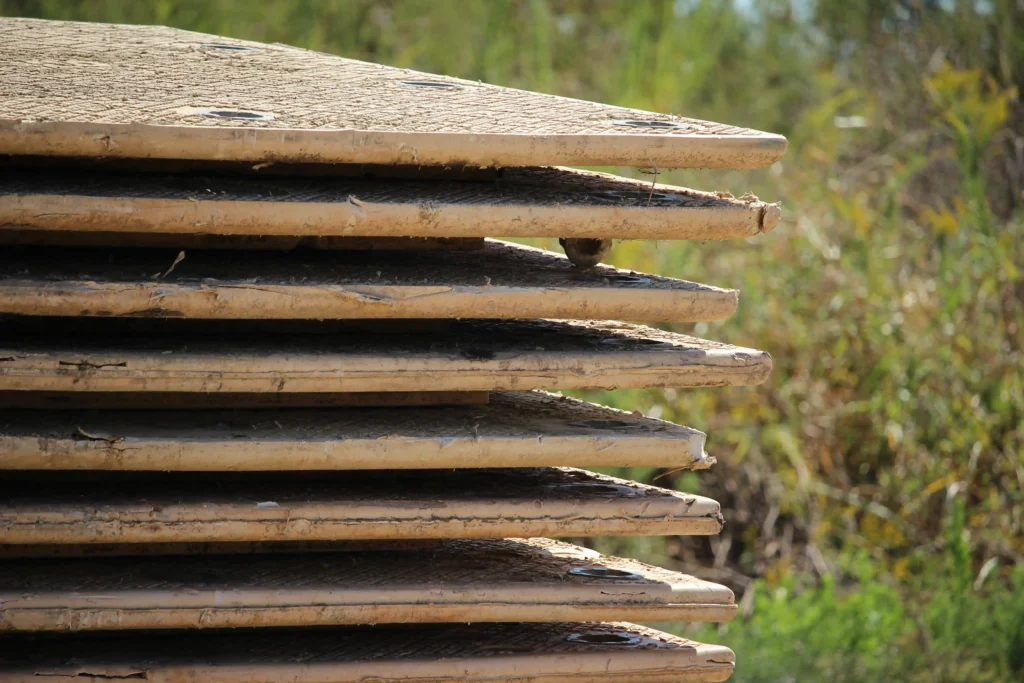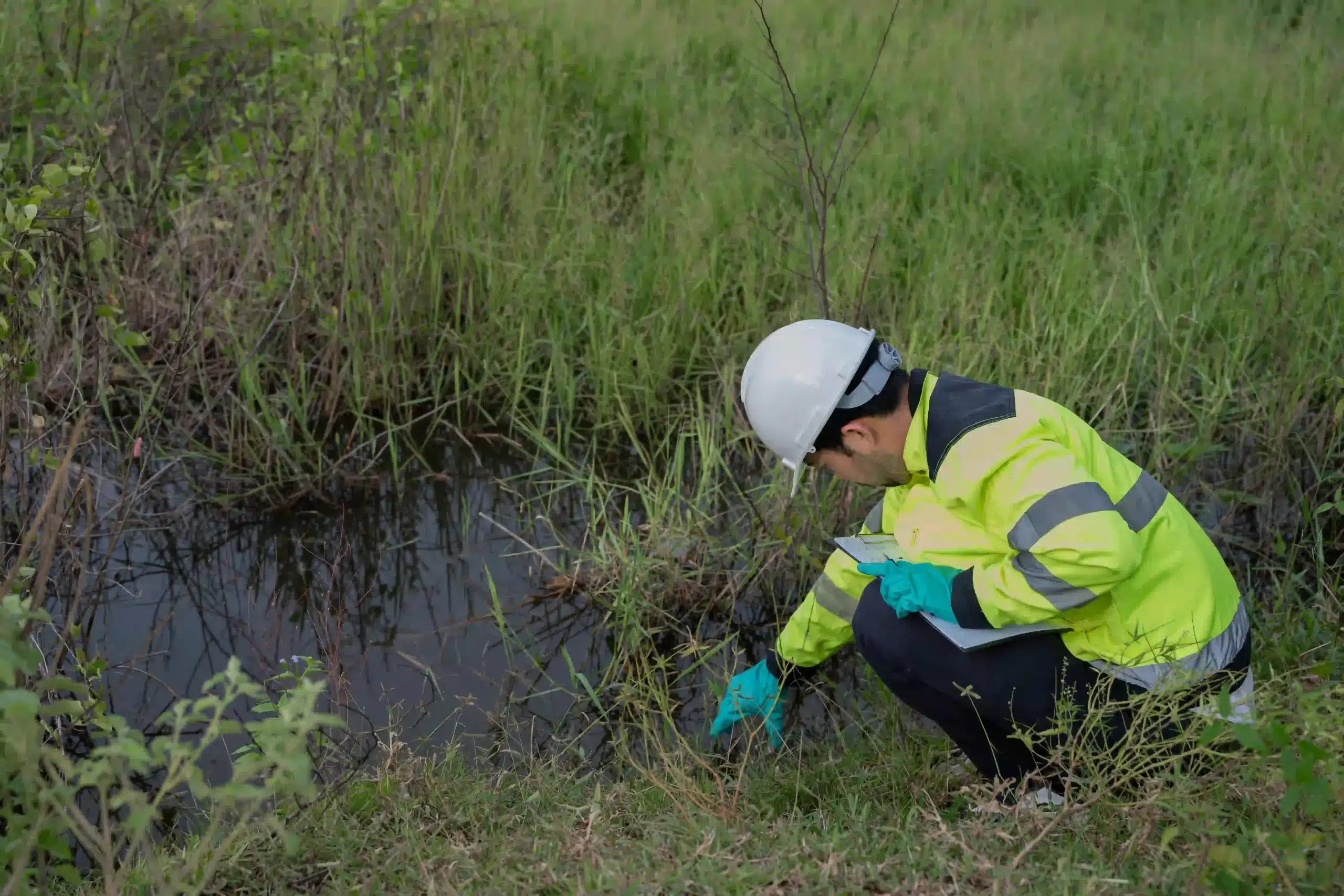
Hardwood laminated mats can carry soil, seeds, and spores between job sites; composite mats cut that cross-contamination risk because they don’t absorb material and are easier to clean.
This is a companion piece to our parent guide, Hardwood Laminated Mats vs. Composite Mats: How to Choose the Right Access Mat for Your Project.
Environmental considerations are an important part of choosing the right construction road mat. Our ultimate guide to choosing construction road mats covers the key factors to consider when matching mat type and performance to ground conditions, project requirements, traffic, and site-specific risks.
Key Findings
- Moving equipment and material between sites is a recognized pathway for spreading invasive species. Federal and state agencies specifically call for cleaning equipment before it leaves one site and enters another. [1][2][3]
- Porous hardwood retains soil, seeds, spores, and organic material, which is exactly what agencies flag as the transfer risk when machinery and materials move between locations. [2][3]
- Composite HDPE is non-porous and absorbs almost no water or material, so it’s easier to inspect and clean and carries less between sites. [5][6]
- Risk rises on wet projects, agricultural land, long-duration jobs, and sites with weak cleaning protocols — the conditions where mats pick up and hold the most material.
- Cleaning between sites is a compliance issue, not just good practice. Agencies including USDA and the U.S. DOT treat contaminated equipment as a spread vector to be managed, and remediating a contaminated site can mean revegetation and re-seeding of disturbed ground. [1][4][7]
Bottom line: Environmental risk is easy to overlook, but it’s real. If you move soil, you move risk.
Why mat contamination is a real risk, not a hypothetical one
The reason agencies publish equipment-cleaning guidance is that contaminated gear is a documented way invasive species travel. Invasive plants and their seeds hide in the soil, mud, and debris that pack into equipment, and moving that material from one site to another spreads them. [1] Access mats are part of that picture: they sit directly on the ground, absorb and trap material, and then get trucked to the next job. A mat that leaves a weedy or infested site carries whatever it picked up straight onto the next one unless it’s cleaned first. That’s why the USDA, the U.S. Forest Service, and state natural-resource departments all recommend cleaning equipment and materials at designated stations before leaving an infested area and before entering a clean one. [1][2][3]
What gets carried between sites
Hardwood laminated mats can transport soil, seeds, spores, fungi, and other organic material from one job to the next. Because wood is porous, that material doesn’t just sit on the surface — it lodges in the grain, works into seams and fastener holes, and soaks in with water and mud. The Forest Service’s best-management practices for timber operations single out equipment and moved material as a carrier for invasive plant propagules, and recommend cleaning specifically to break that pathway. [2] State guidance is just as direct: remove soil, mud, and plant debris from equipment before it moves between sites. [3]
Why it matters: ecology and compliance
Cross-contamination has consequences well beyond a dirty mat.
The ecological cost is the introduction of invasive species into a new area. Once established, invasive plants can outcompete native vegetation, degrade habitat, and are expensive to control — which is why prevention through cleaning is the front-line strategy agencies recommend. [1][2]
The agricultural cost is disruption to farmland. Moving contaminated material onto or off of agricultural ground can carry weed seed and pathogens into productive soil, and remediating disturbed or contaminated ground can require revegetation and re-seeding to stabilize the area and prevent erosion. [7]
The compliance cost is regulatory exposure. Federal and state programs treat contaminated equipment as a spread vector to be managed, and projects on or near sensitive habitat and farmland can carry cleaning and inspection obligations. The U.S. DOT has developed equipment-washing guidance specifically because construction vehicles catch and move invasive species. [4] Skipping the cleaning step isn’t just an ecological risk — it can be a documentation and compliance gap.
Where the risk increases
Four conditions raise the odds that a mat carries material between sites. Wet projects load mud and water into and onto the mat, saturating porous timber. Agricultural areas put mats in direct contact with abundant seed and soil. Long-duration jobs give mats time to collect and hold organic material. And weak or missing cleaning protocols let whatever the mat picked up ride, unchecked, to the next site. When several of these overlap — a long wet job on farmland with no cleaning step — the transfer risk is at its highest.
Cleaning: where the two mat types differ
| Factor | Hardwood Laminated Mats | Composite Mats |
|---|---|---|
| Material behavior | Absorb water and material; trap debris internally | Non-porous; nothing absorbs in |
| Cleaning effort | Higher — debris lodges in seams and grain | Lower — rinses and wipes clean [5][6] |
| Inspection | Harder to verify fully clean | Easier to inspect between sites |
| Contamination carry-over | Higher | Lower |
Porous timber holds material inside the wood and in its seams, so it takes more effort to clean and is harder to verify as fully decontaminated — a real problem when the goal is to certify a mat is clean before it moves. Composite HDPE doesn’t absorb water or material, so debris stays on the surface where it can be rinsed off, and the mat is far easier to inspect and sign off between sites. [5][6] Easier cleaning isn’t only a labor saving; it makes reliable decontamination achievable, which is the whole point of the exercise.
Best practices to reduce cross-contamination
- Clean mats before transport. Remove soil, mud, and plant debris before mats leave a site — the step agencies specifically recommend to prevent spread. [1][3]
- Inspect and document. Check seams, edges, and surfaces for lodged soil and organic material before loading, and keep a record — useful if a project has compliance obligations. [4]
- Use designated cleaning points. Where possible, wash equipment at a set location before leaving an infested site and before entering a clean one, per agency guidance. [1][3]
- Separate mats by region. Keep mats used on sensitive or infested sites out of clean-site inventory to avoid mixing contamination.
- Match the mat to the exposure. On wet, agricultural, or compliance-sensitive projects, weigh a non-absorbent composite surface against porous timber — it’s easier to keep and verify clean. See the parent guide.
FAQ
Can construction mats really spread invasive species between sites?
Yes — it’s a recognized pathway. Federal and state agencies, including USDA APHIS, the U.S. Forest Service, and state natural-resource departments, identify equipment and moved material as a route for carrying invasive seeds, soil, and spores between sites, and recommend cleaning before mats leave one location and enter another. [1][2][3]
What do hardwood laminated mats carry between job sites?
Because wood is porous, hardwood mats can retain and transport soil, seeds, spores, fungi, and other organic material. That material lodges in the grain and seams, which is exactly the transfer risk agencies warn about when machinery and materials move between locations. [2][3]
Why are composite mats lower environmental risk?
Composite HDPE is non-porous and absorbs almost no water or material, so far less soil and organic matter rides along with it, and it’s easier to inspect and clean between sites. [5][6] That reduces the chance of carrying contaminants or invasive species from one job to the next.
When is cross-contamination risk highest?
On wet projects, agricultural land, long-duration jobs, and sites with weak cleaning protocols. Those conditions load the most soil, seed, and organic material onto and into the mats — and without a cleaning step, that material moves to the next site. [1]
Is cleaning mats between sites actually required?
It depends on the project, but it’s treated as more than a courtesy. Federal and state agencies recommend — and in many programs expect — that equipment and materials be cleaned before moving between sites, and the U.S. DOT has published equipment-washing guidance aimed at construction vehicles specifically. [1][4] On projects near sensitive habitat or farmland, cleaning and inspection can be a documented compliance requirement, so it’s worth confirming the rules for each site.
How do I reduce cross-contamination from mats?
Clean mats before they leave a site, inspect seams and surfaces for lodged soil and debris, use designated cleaning points, and separate mats by region so sensitive-site inventory doesn’t mix with clean-site inventory. On high-risk projects, a non-absorbent composite surface is easier to keep and verify clean. [1][3][5]
Sources
- How To Stop Invasive Pests (clean equipment to avoid spreading seeds, soil, and spores) — USDA APHIS
- Proposed BMPs for Invasive Plant Mitigation during Timber Harvest (GTR-NRS-118) — USDA Forest Service
- Cleaning Heavy Equipment to Minimize the Spread of Invasive Species — Minnesota DNR
- DOTWASH Tackles Invasive Species on Construction Vehicles — U.S. DOT Volpe Center
- High-Density Polyethylene (HDPE): Definition, Properties, and Uses — Xometry
- High Density Polyethylene (HDPE) material properties — MakeItFrom
- Managing Soil Compaction and Revegetation of Disturbed Areas — USDA Natural Resources Conservation Service