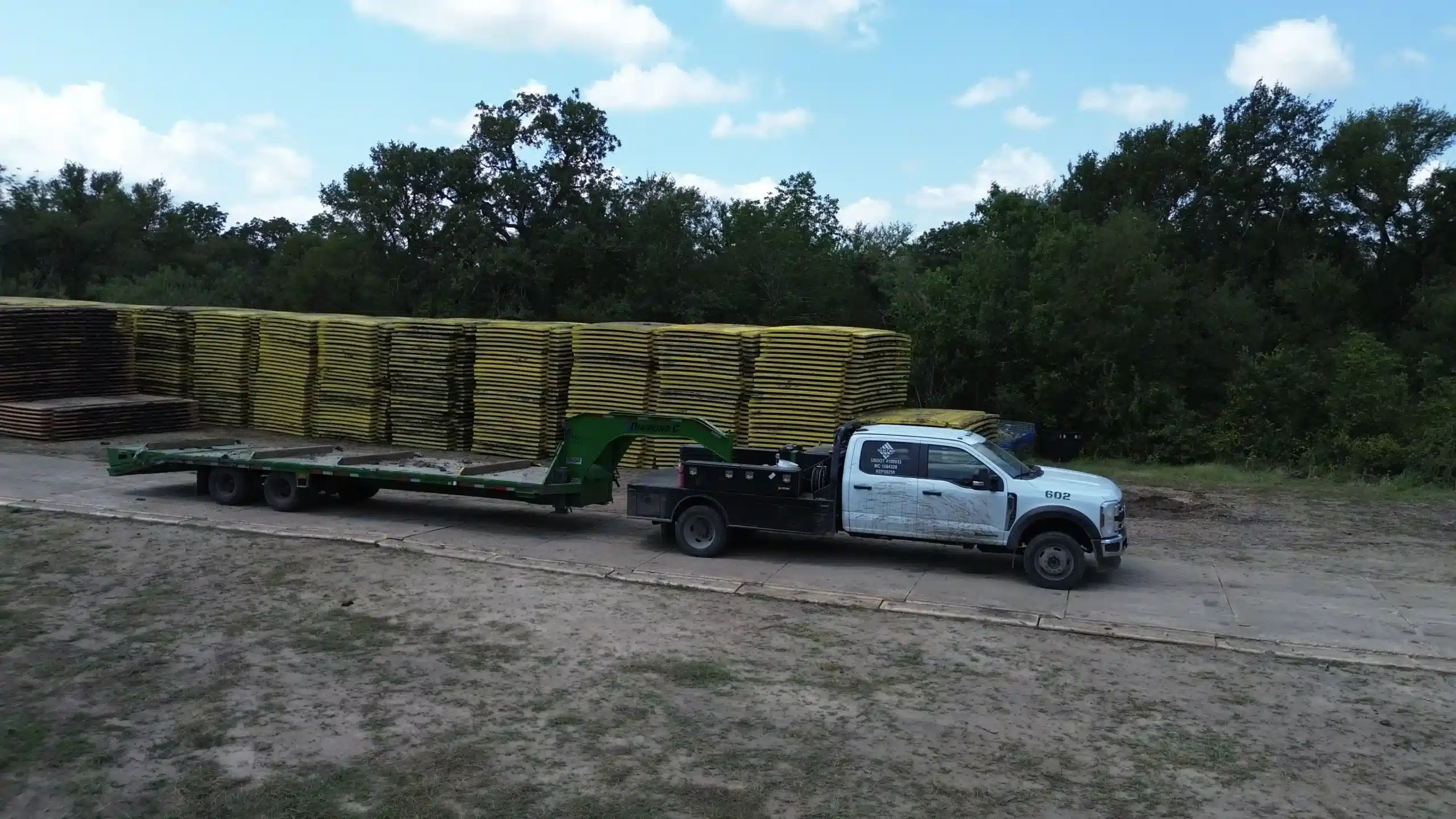
On large projects, the real cost gap between mat types comes from freight, install time, and load-out — not the rental rate alone.
This is a companion piece to our parent guide, Hardwood Laminated Mats vs. Composite Mats: How to Choose the Right Access Mat for Your Project.
Key Findings
- A truck is capped by weight, not space — the federal interstate limit is 80,000 lb gross vehicle weight, so the lighter mat system fits more square footage per load. [1]
- Composite mats are roughly half the weight of equivalent timber because HDPE absorbs almost no water, while hardwood is dense and picks up water and mud in the field. That weight gap is what lets composite carry close to 2x the coverage per truckload. [2][3][4][5]
- Fewer trucks cuts more than freight. It lowers fuel, driver time, scheduling complexity, on-site congestion, and install time — costs most rate-only comparisons miss.
- Hardwood mats often leave heavier than they arrive. Retained water, mud, and organic material can add outbound trucks at removal. [4][5]
- Lower freight does not always mean lower total cost. In the illustrative model below, composite saves on trucking but its higher rental rate makes total project cost higher — so duration and rate matter as much as logistics.
Bottom line: Upfront rate is only part of the equation. The bigger the project, the more logistics decide the real cost.
How much more does a composite truck carry?
Close to twice as much, and it comes down to weight. A standard truck on the interstate system is limited to 80,000 lb gross vehicle weight by federal rule, so once you hit that ceiling, the lighter system simply fits more deck on the trailer. [1] Composite HDPE absorbs almost no water and weighs far less than hardwood, while timber is dense and gains water weight on site — so the same weight-limited truck moves more composite square footage per load. [2][3][4][5]
| Metric | Hardwood Laminated | Composite |
|---|---|---|
| Mats per truck | ~16–20 (varies with moisture and length) | ~40+ |
| Coverage per mat | ~112–128 sq ft (14′/16′) | ~85–91 sq ft |
| Coverage per load | ≈ 2,000–2,200 sq ft | ≈ 4,000+ sq ft |
Per-mat and per-truck figures are operational estimates — see editorial note.
For a 40,000 sq ft project, that’s roughly 10 trucks for composite versus 18–20 trucks for hardwood laminated — close to double the trucking.
Where logistics becomes the real cost driver
Three logistics costs sit outside the rental rate and grow with project size.
Freight scales with truck count: more loads mean more fuel, more driver hours, and more scheduling complexity on both delivery and removal. Site congestion rises with every truck — more on-site traffic, more delivery risk, and longer install windows. And installation time shrinks when there are fewer loads to place, which reduces labor exposure and gets the project working sooner.
The cost model: freight savings vs. rental rate
Composite wins on freight. Whether it wins on total cost depends on rental rate and duration. The two tables below use the same assumptions — $1,000 per truck, hardwood at $1.85/mat-day, composite at $2.50/mat-day — and show how the answer flips with project length.
Short project (90 days)
| Line item | Laminated | Composite |
|---|---|---|
| Coverage | 40,000 sq ft | 40,000 sq ft |
| Duration | 90 days | 90 days |
| Cost per truck | $1,000 | $1,000 |
| Mat quantity | 358 | 440 |
| Trucks | 18 | 10 |
| Rental rate | $1.85 /mat-day | $2.50 /mat-day |
| Total freight IN | $18,000 | $10,000 |
| Total freight OUT* | $21,600 | $10,000 |
| Project cost | $99,207 | $119,000 |
| Effective cost per mat-day | $3.08 | $3.01 |
Long project (200 days)
| Line item | Laminated | Composite |
|---|---|---|
| Coverage | 40,000 sq ft | 40,000 sq ft |
| Duration | 200 days | 200 days |
| Cost per truck | $1,000 | $1,000 |
| Mat quantity | 358 | 440 |
| Trucks | 18 | 10 |
| Rental rate | $1.85 /mat-day | $2.50 /mat-day |
| Total freight IN | $18,000 | $10,000 |
| Total freight OUT* | $21,600 | $10,000 |
| Project cost | $172,060 | $240,000 |
| Effective cost per mat-day | $2.40 | $2.73 |
Freight OUT reflects moisture pickup that adds outbound hardwood trucks. Figures are an illustrative model with the assumptions stated above, not third-party pricing — see editorial note.
The pattern: composite’s freight advantage is large and immediate, but its higher rental rate carries every day of the project. On short jobs the two land near parity per mat-day ($3.01 vs $3.08); on long jobs the lower rental rate pulls hardwood ahead on total cost. Logistics decides the short-term math; rental rate and duration decide the long-term math.
How project duration changes the decision
For short-term projects (under ~6–9 months), composite mats are often preferred: the trucking savings land immediately, install and removal are faster, and the surface performs consistently.
For longer-term projects, the one-time trucking advantage gets diluted across more rental days, and hardwood’s lower rate can win on total cost — but only if maintenance is actively managed and some surface degradation is acceptable. (We cover board-road gap management in a separate companion piece.)
The hidden factor: load-out reality
Hardwood laminated mats often leave a site heavier than they arrived, because they retain water, mud, and organic material. [4][5] That extra weight means more outbound trucks, higher removal cost, and additional handling — which is why the freight-out figure in the model above exceeds freight-in for hardwood. Composite HDPE does not absorb material, so its load-out weight stays close to its delivered weight. [2][3]
Environmental and cleaning costs most estimates skip
Hardwood laminated mats can carry post-project costs beyond freight: cleaning before reuse, inspection for contamination, on-site remediation for soil compaction and re-seeding of disturbed ground, and cleanup of timber shards and splinters. Heavy equipment on bare soil causes compaction that often needs mechanical remediation, and disturbed areas typically need revegetation to prevent erosion. [6] Moving timber between sites also carries a recognized risk of transferring soil, seed, and invasive species. [7] Splinters, broken boards, and protruding fasteners add housekeeping obligations, since work areas must be kept clear of debris and scrap with protruding nails. [8] Composite mats don’t absorb material, are easier to clean, and reduce handling time. [2][3]
How to compare true cost in five steps
- Start with coverage and duration, not the rate sheet — they drive everything below.
- Count trucks both ways. Estimate loads in and out, and add outbound trucks for hardwood moisture pickup.
- Add freight to the rate. Combine rental (rate × mats × days) with freight in and out for each option.
- Price the soft costs. Install time, labor exposure, cleaning, soil remediation, and re-seeding belong in the comparison. [6]
- Let duration break the tie. Short jobs favor composite’s logistics; long jobs can favor hardwood’s lower rate — if maintenance is managed.
FAQ
How much more ground can a composite mat truck carry than a hardwood mat truck?
Close to twice as much. A truck is limited by weight — 80,000 lb gross on the interstate system under federal rule — so the lighter system fits more deck per load. [1] Composite HDPE weighs about half what equivalent timber does and absorbs almost no water, while hardwood is dense and gains water weight on site, so a composite load covers roughly 4,000+ sq ft versus about 2,000–2,200 sq ft for hardwood laminated. [2][3][4][5]
Does fewer trucks mean composite mats are cheaper overall?
Not necessarily. Composite almost always wins on freight, but total project cost also depends on the rental rate and how long the mats are on site. In the model above, composite saves on trucking yet costs more in total because its higher daily rate carries across the whole project. Compare full project cost — rental plus freight in and out — not freight alone.
Why do hardwood mats cost more to haul out than to deliver?
Because they get heavier on site. Hardwood absorbs water, mud, and organic material, so a mat that arrived at one weight can leave noticeably heavier. [4][5] Since trucks are weight-limited, that added weight can require more outbound trucks at removal, raising freight-out above freight-in.
What costs do most mat estimates miss?
Most comparisons stop at the rental rate or purchase price. They leave out freight in and out, installation time, labor exposure, site efficiency, and post-project costs like cleaning, soil-compaction remediation, and re-seeding. [6] On large or long projects, those omitted costs often outweigh the rate difference.
When do hardwood laminated mats still make sense on cost?
On longer-duration projects where the lower daily rental rate has time to outweigh composite’s one-time freight advantage — provided the team actively manages maintenance and can accept some surface degradation. The model above shows hardwood pulling ahead on total cost at 200 days.
Do composite mats reduce cleanup and environmental costs?
They reduce several. Composite HDPE doesn’t absorb water or material, so it’s easier to clean, lowers handling time, and avoids splinters and broken-board debris. [2][3] It also lowers the risk of transferring soil, seed, and invasive species between sites compared with porous timber. [7] Hardwood projects more often involve cleaning, contamination inspection, and on-site soil remediation. [6]
Sources
- Truck Size and Weight — Federal 80,000 lb gross vehicle weight limit (23 CFR 658.17) — FHWA / Cornell Legal Information Institute
- High-Density Polyethylene (HDPE): Definition, Properties, and Uses — Xometry
- High Density Polyethylene (HDPE) material properties — MakeItFrom
- Wood Handbook, Chapter 4: Moisture Relations and Physical Properties of Wood — USDA Forest Products Laboratory
- Calculating the Green Weight of Wood Species — Penn State Extension
- Managing Soil Compaction (heavy-equipment compaction, subsoiling, revegetation) — USDA Natural Resources Conservation Service
- How To Stop Invasive Pests — USDA APHIS
- Walking-Working Surfaces (housekeeping; debris and protruding nails) — OSHA