Key Findings
-
- Composite mats are roughly half the weight of equivalent timber because HDPE absorbs almost no water, while timber is dense and gains substantial water weight in the field. Because trucks are weight-limited, the lighter system fits close to 2x the coverage per load. [1][2][3][4]
-
- Wet timber mats gain significant weight. Green and water-logged wood is largely water by mass, so timber that absorbs field moisture is far heavier to haul out than it was to bring in. Composite HDPE absorbs under ~0.1% water by weight. [1][2][3][4]
-
- Composite HDPE is non-porous, so it resists transferring soil, seed, spores, and invasive species between sites. Federal and state agencies identify equipment and material moving between sites as a known pathway for invasive spread. [3][4][5][6][7][8]
-
- 3-ply laminated mats are bonded hardwood, ~4″–4.5″ thick, fastened with steel bolts or nails that can become exposure hazards as the surface wears. [9]
-
- Composite mats interlock into a continuous surface, while timber mats are placed as independent units (a “board road”) — the structural difference behind most safety and maintenance outcomes. [9]
Bottom line: Match the mat to the job — not the job to the mat.
What’s the difference between hardwood laminated mats and composite mats?
Hardwood laminated mats and interlocking composite mats are both access mat solutions, but they behave differently on site. An access mat is a portable platform that spreads heavy equipment loads across soft or uneven ground so vehicles don’t sink, get stuck, or cut deep ruts. [9]
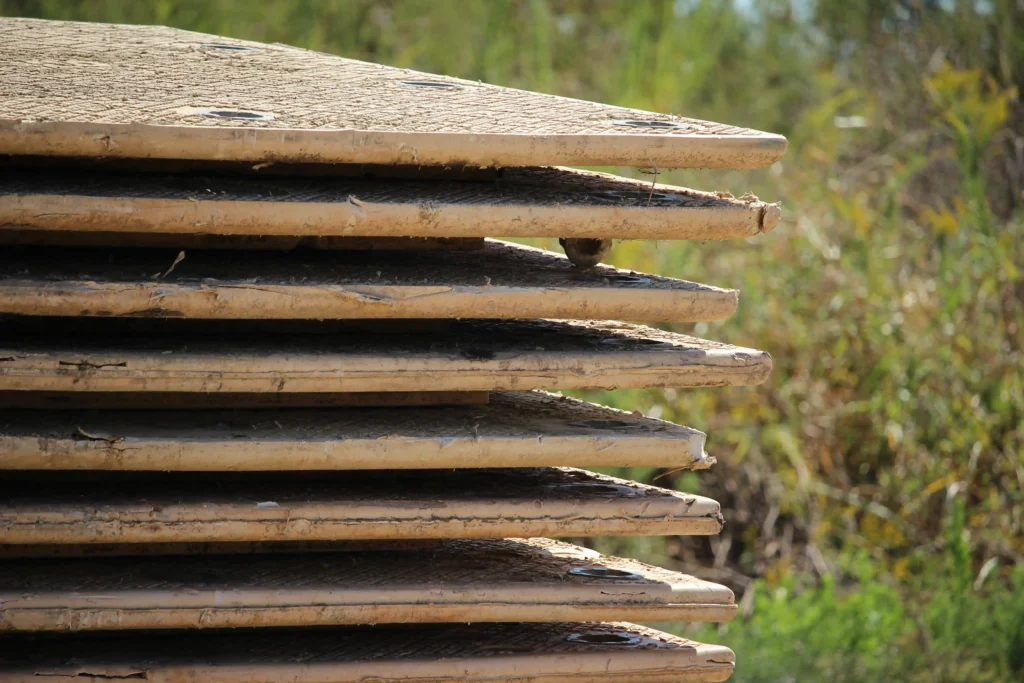
A hardwood laminated mat bonds layers of hardwood boards into a single unit and is placed alongside other mats to build a board road. It carries a lower upfront cost. Over time, board roads can develop gaps, shifting surfaces, and inconsistent working conditions. Learn more about Board Road Gaps and Why Harwood Laminated Mats Separate in our companion piece.
An interlocking composite mat is an engineered polymer panel — usually high-density polyethylene (HDPE) — joined with pins into one connected surface. It carries a higher upfront cost but holds its performance through the project. The continuous surface reduces trip hazards, mat movement, and surface inconsistency.
There are still jobs where a hardwood laminated mat is the right call. The decision depends on duration, ground, logistics, and safety exposure.
Why access mat selection matters more than the per-mat price
Access matting sets how the whole project runs. It governs how safely crews move on site, how consistently equipment operates, how ground conditions hold up, and how fast the work finishes.
Most decisions still start with cost per mat. That number is incomplete. A real evaluation weighs four factors: safety risk over time, installation and trucking logistics, ground conditions and project duration, and environmental impact.
The core difference: board road vs. continuous surface
This is the most important concept in access matting, and it drives the safety, cost, and performance outcomes below.
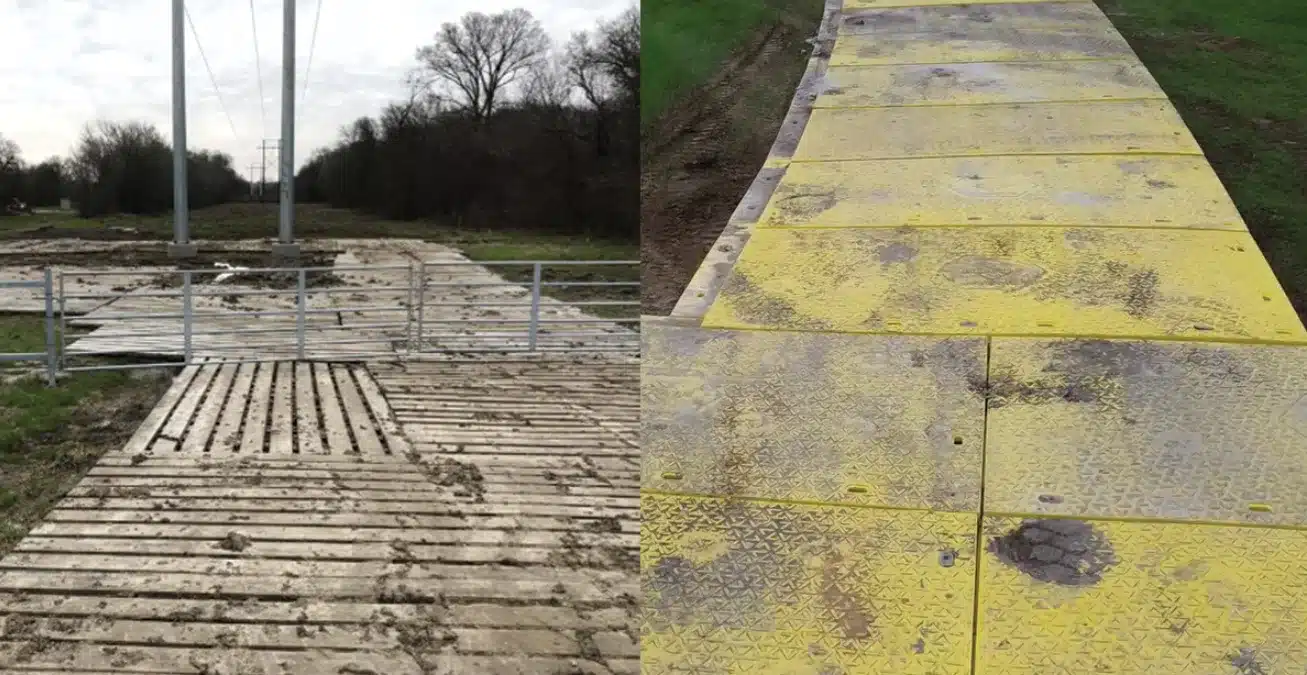
A board road (hardwood laminated mats) is separate mats set side by side. The surface evolves with traffic and weather, and it needs ongoing maintenance to keep proper ground support.
A continuous surface (composite mats) is panels interlocked into one system. The surface stays uniform and predictable, and maintenance stays minimal.
How do the two systems compare on specs?
3-ply laminated timber mats bond three layers of solid hardwood and are bolted or nailed together; they run roughly 4″–4.5″ thick in standard 8′-wide sizes. [9] Composite mats are engineered HDPE panels around 4″ thick that interlock with pins.
| Feature | Hardwood Laminated Mats | Composite Mats |
|---|---|---|
| System type | Board road (independent mats) | Continuous interlocking system |
| Material | 3-ply bonded hardwood | Engineered HDPE polymer |
| Thickness | ~4″–4.5″ | ~4″ |
| Upfront cost | Lower | Higher |
| Performance over time | Degrades with traffic and weather | Stays consistent through the project |
| Surface behavior | Gaps, shifting, unevenness | Uniform, predictable, connected |
| Safety risks | Trip hazards, splinters, broken boards, bolt/nail exposure | Reduced gaps, fewer inconsistencies |
| Maintenance | Ongoing (realignment, repairs) | Minimal |
| Weight / trucking | Heavier; gains water weight in field | ~Half the weight; near-zero water absorption [1][2][3][4] |
| Installation speed | Moderate | Faster (system-based) |
| Environmental impact | Absorbs mud/water; higher contamination risk | Non-absorbent; easier to clean |
| Best for | Cost-sensitive, long-duration, stable ground | Safety-critical, wet/unstable ground, logistics-heavy projects |
What are the safety trade-offs over time?
As board roads age, they tend to introduce gaps that become trip hazards, mat movement that creates uneven surfaces, surface degradation that exposes splinters, broken boards, and bolt or nail heads, and mud and water buildup that cuts traction. These risks grow with time and traffic. [9]
Composite systems cut gaps, surface inconsistency, and material breakdown, but they still demand attention to load ratings, spill management, and ground monitoring for subsidence. Learn more about Construction Mat Safety and How Surface Consistency Prevents Trips and Worker Injuries in our companion piece.
How much do logistics change the math?
Trucking is the hidden cost driver, and it comes down to weight. HDPE absorbs almost no water — under roughly 0.1% by weight in standard material testing — so composite mats stay light. [3][4] Timber is the opposite: wood is dense, and green or water-logged wood is largely water by mass, so field-soaked timber is heavy. [1][2] Because trucks are weight-limited, the lighter composite system carries close to twice the square footage per load, which compounds across freight cost, project timeline, and site congestion on larger jobs. Check out our companion piece that dives deeper into trucking costs with full breakdown charts – Composite Mats vs. Hardwood Laminated Mats: Trucking, Logistics & True Project Cost.
Removal widens the gap further. Timber absorbs water and mud in the field and hauls out heavier than it arrived, so it can take more trucks to remove than to deliver. Composite HDPE does not absorb water, so its load-out weight stays close to its delivered weight. [1][2][3][4]
Note: specific per-truck coverage figures circulated in the industry (roughly 3,380–4,095 sq ft per load for composite vs. ~1,500–2,048 sq ft for laminated timber) come from vendor/operational sources, not third-party testing. The directional ~2x advantage is grounded in the weight difference above. [VENDOR FIGURE — confirm with your own load data before publishing exact numbers]
How does project duration shift the decision?
For short-term projects (under ~6–9 months), composite mats are often preferred for reduced trucking, faster install and removal, and consistent performance. For longer-term projects, hardwood laminated mats can compete on upfront cost but require more maintenance and monitoring. Past roughly the 9-month mark, laminated mats hold a stronger competitive cost position.
Note: the 6–9 month and 9-month crossover points are industry rules of thumb that depend on traffic, ground, and freight distance. They are directional, not fixed thresholds. [NEEDS SOURCE — internal benchmarking or third-party cost study to substantiate the crossover point]
For pipeline teams comparing mat types by equipment, freight, and ground conditions, this guide on composite vs. timber mats for pipeline projects offers a deeper breakdown.
What’s the environmental and contamination difference?
Timber mats absorb water and mud and retain organic material, which raises removal weight and introduces cross-contamination risk: soil, seeds, spores, and invasive species can transfer from one site to the next. Federal and state agencies — including USDA APHIS, the U.S. Forest Service, the U.S. DOT, and state natural-resource departments — identify equipment, vehicles, and moved material as a known pathway for spreading invasive species, and recommend cleaning between sites. [5][6][7][8] Composite HDPE is non-porous, so it does not absorb material, is easier to clean, and lowers contamination and invasive-species risk between jobsites — an important factor for environmental compliance. [3][4] To learn more about the Environmental Risks of Construction Mats, please see our companion piece.
When does each mat type make sense?
Hardwood laminated mats fit cost-sensitive projects, longer durations (6+ months), controlled-traffic environments, and stable, unchanging ground.
Composite mats fit worker foot traffic, mixed-use access roads, wet or unstable ground, logistically complex projects, and safety-critical environments.
For more information on choosing the best mat type for your project, see our companion piece, When to Use Composite Mats vs. Hardwood Laminated Mats.
Action plan: how to choose in seven steps
- Fix the project duration. Under ~9 months leans composite; well past 9 months reopens the case for laminated timber on upfront cost.
- Read the ground. Stable and dry supports timber; wet, soft, or shifting ground favors a continuous composite surface.
- Map the logistics. Estimate truckloads from mat weight — composite runs about half the weight of timber and gains no water weight in the field, so it carries roughly twice the coverage per load. [1][2][3][4]
- Score safety exposure. Weight foot traffic, public access, and regulated environments toward the continuous surface.
- Check environmental compliance. In sensitive or chemical-exposure areas, the non-absorbent, easy-to-clean composite reduces contamination and invasive-species risk. [5][6][7]
- Compare total cost, not cost per mat. Add freight in, maintenance, and freight out (including water weight) to the mat price.
- Match the mat to the job. Let the requirements pick the system.
FAQ
Are composite mats better than hardwood laminated mats?
Not universally — they are better for specific conditions. Composite mats win on safety consistency, trucking efficiency, and environmental risk because they interlock into a continuous, non-absorbent surface. Hardwood laminated mats still win on upfront cost and can be the right choice for long-duration projects on stable ground. The right answer depends on duration, ground conditions, logistics, and safety exposure. To learn more about Composite Mat Limitations, please see our companion piece.
When do hardwood laminated mats still make the most sense?
They make sense on cost-sensitive, long-duration projects (roughly 6+ months) with controlled traffic and stable, unchanging ground. In those conditions the lower upfront cost can outweigh the added maintenance and the heavier, wetter load-out at removal.
How much more ground does a composite mat cover per truckload?
Close to twice as much, and it comes down to weight. HDPE absorbs almost no water, while timber is dense and gains water weight in the field, so a weight-limited truck carries far more composite square footage per load. [1][2][3][4] On large jobs this directly lowers freight cost, shortens timelines, and reduces site congestion.
Do timber mats really spread invasive species between sites?
It’s a recognized risk. Timber is porous and retains soil, seeds, spores, and organic material, and federal and state agencies identify moving equipment and material between sites as a known pathway for invasive spread. [5][6][7][8] Composite HDPE is non-porous and easier to clean, which is why it’s often preferred in environmentally sensitive or regulated areas.
Which mat type is cheaper overall?
It depends on how you count. Hardwood laminated mats are cheaper per mat and cheaper upfront. Composite mats can be cheaper in total once you add freight (about half the weight per load), faster install and removal, lower maintenance, and lighter load-out, because timber gains weight as it absorbs water. [1][2][3][4] Compare total cost across the full project, not cost per mat.
How thick is a 3-ply laminated hardwood mat?
3-ply laminated mats bond three layers of hardwood, run roughly 4″–4.5″ thick in standard 8′-wide sizes, and are fastened with steel bolts or nails. [9] The board road they form needs ongoing realignment and repair as traffic and weather wear the surface.
Sources
- Wood Handbook, Chapter 4: Moisture Relations and Physical Properties of Wood — USDA Forest Products Laboratory
- Calculating the Green Weight of Wood Species — Penn State Extension
- High-Density Polyethylene (HDPE): Definition, Properties, and Uses — Xometry
- High Density Polyethylene (HDPE) material properties — MakeItFrom
- How To Stop Invasive Pests — USDA APHIS
- Proposed BMPs for Invasive Plant Mitigation during Timber Harvest (GTR-NRS-118) — USDA Forest Service
- Cleaning Heavy Equipment to Minimize the Spread of Invasive Species — Minnesota DNR
- DOTWASH Tackles Invasive Species on Construction Vehicles — U.S. DOT Volpe Center
- Access mat — Wikipedia