
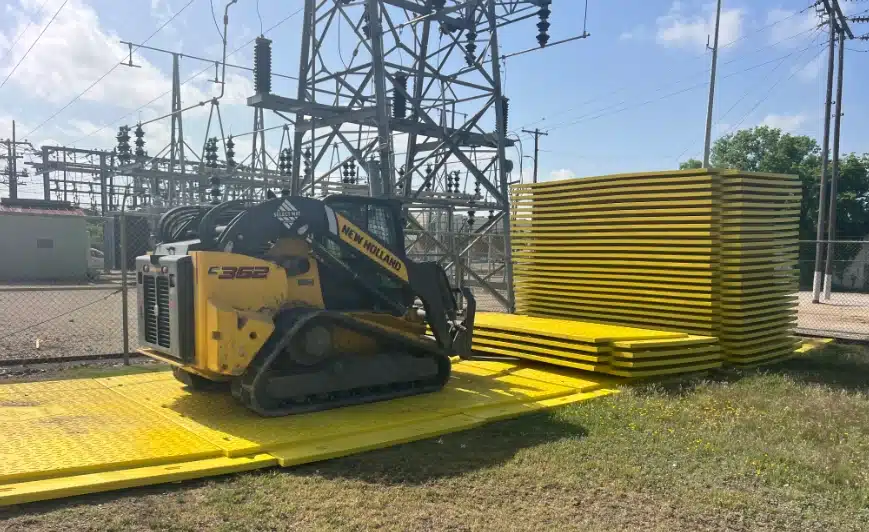
Quick Answer: Construction mats (also called access mats, swamp mats, or mud mats) provide stable, temporary ground access for heavy equipment on pipeline, transmission and distribution (T&D), and construction sites. Choose from 5 main types: laminated mats (light-duty, rubber-tired), CLT mats (lightweight, engineered), composite mats (versatile, all-weather), timber mats (heavy-duty tracked), and crane mats (maximum capacity).
Navigating unstable terrain on construction, pipeline, and T&D projects requires reliable ground protection solutions. Whether you’re working across swamps, muddy fields, or environmentally sensitive areas, the right construction mat can mean the difference between on-schedule completion and costly delays.
This comprehensive 2025 guide details the most common mat types in the industry for your construction needs, including best uses, specifications, and purchase options.
What Are Construction Mats?
Construction mats (also called access mats, swamp mats, or mud mats) are equipment platforms that provide level, stable ground on construction sites.
Construction projects almost never take place on smooth terrain. Instead, they often pass through swamps, wetlands, and other wilderness areas that are wet and unstable. Access matting allows crews and heavy machinery to navigate these challenging areas safely and with relative ease.
Why Construction Sites Need Access Mats
- Ground Protection: Mats protect underlying soil, vegetation, and ecosystems from damage caused by heavy equipment, preventing costly environmental remediation.
- Equipment Mobility: Mats create stable pathways that prevent vehicles from getting stuck in mud, sand, or soft soil, keeping projects on schedule.
- Safety Compliance: Mats reduce slip, trip, and equipment rollover hazards, improving workplace safety and helping meet OSHA requirements.
- All-Weather Access: Mats maintain site accessibility regardless of weather conditions, reducing weather-related delays.
The 5 Types of Construction Mats
| Mat Type | Best For | Weight | Thickness | Equipment Type | Key Advantage |
| Laminated | Light-duty access | Medium | 3-5″ | Rubber-tired only | Most affordable |
| CLT | Medium-duty access | Light | 4-6″ | Rubber-tired only | 40% lighter freight |
| Composite | All-purpose | Light | 4″ | Both tracked and rubber | Most versatile |
| Timber | Heavy tracked equipment | Heavy | 8″ | Tracked and heavy rubber | Maximum durability |
| Crane | Extreme loads | Very Heavy | 12″ | All equipment types | Highest capacity |
1. Laminated Construction Mats
What Are Laminated Mats?
The laminated mat is historically one of the most widely used construction mats. These consist of three layers of hardwood (3-ply), nailed or bolted together.
Best Applications
- Rubber-tired vehicles only: Service trucks, pickups, and light equipment.
- Temporary site access: Short to medium-term projects.
- Budget-conscious projects: Most affordable wood mat option.
- Light to medium loads: Not suitable for tracked equipment.
Specifications
- Standard Sizes: 8′ × 14′ or 8′ × 16′.
- Construction: Three plywood layers nailed or bolted together.
- Freight Efficiency: Medium (15 to 18 per truckload depending on the size).
Advantages
- Affordability: Lowest upfront cost among wood mat options.
- Proven Track Record: Decades of use have established them as a reliable industry standard.
- Easy Replacement: Individual damaged boards can sometimes be replaced.
Limitations
- Not for Tracked Equipment: Cannot withstand the concentrated pressure from steel tracked vehicles.
- Heavier Than Alternatives: Higher freight costs compared to CLT or composite options.
- Shorter Lifespan: Wood degrades faster than composite materials in wet conditions.
2. CLT Mats (Cross-Laminated Timber)
What Are CLT Mats?
CLT mats are similar to laminated mats but with significant improvements. They are lighter weight, which saves on freight costs and makes them easier to install. Unlike laminated mats, they are made of softwood pine and joined by strong adhesives rather than nails or bolts.
Best Applications
- Rubber-tired vehicles: Light to medium equipment.
- Freight-sensitive projects: Save up to 40% on transportation.
- Quick mobilization: Lighter weight speeds up installation.
- Sustainable projects: Fast-growth pine is environmentally friendly.
Specifications
- Standard Sizes: 8′ × 14′ or 8′ × 16′.
- Construction: Three layers of pine, adhesive-bonded, and cross-laminated.
- Freight Efficiency: Up to 40% lighter than laminated mats (18 to 33 per truckload).
Advantages
- Significant Freight Savings: More mats per truckload means fewer delivery vehicles required.
- Faster Installation: Lighter weight allows smaller crews to handle repositioning quickly.
- Engineered Strength: The adhesive bonding creates a rigid mat that supports substantial weight.
- Environmental Sustainability: Pine reaches harvest maturity faster than hardwoods.
Limitations
- Not for Tracked Equipment: 3-layer versions cannot support steel tracked machinery.
- Less Flexible: Wood construction limits the ability to conform to uneven terrain.
- Delamination: Risk of delamination between the layers over time.
3. Composite Construction Mats
What Are Composite Mats?
Composite mats are becoming the nation’s biggest seller because they offer numerous advantages over wood. Made from high-density polyethylene (HDPE), they are stronger and more durable than laminated or CLT matting.
Best Applications
- All equipment types: Both tracked and rubber-tired.
- Oil and Gas facilities: Non-absorbent and chemical-resistant.
- T&D projects: Electrically non-conductive.
- Wetland crossings: Excellent for environmentally sensitive areas.
- Long-term reusability: High recovery rate after jobs.
Specifications
- Material: High-density polyethylene (HDPE).
- Standard Sizes: 8′ x 14′.
- Freight Efficiency: Lightweight (average 40 to 45 mats per truckload).
- Flexibility: High (conforms to uneven terrain).
Advantages
- Universal Compatibility: Works effectively with both tracked and rubber-tired vehicles.
- Superior Durability: HDPE does not rot, splinter, or degrade like wood.
- Contaminant Resistance: Does not absorb oil or chemicals. Prevents cross-contamination of seeds or fungus between sites.
- Weather Performance: Does not become waterlogged or freeze.
- High Reusability: Exceptionally high rate of recovery after projects.
4. Timber Construction Mats
What Are Timber Mats?
Timber mats are constructed from solid hardwood timber bolted together with steel hardware. This heavy-duty solution is used extensively in oil, gas, and utilities.
Best Applications
- Steel Tracked equipment: Excavators, dozers, and tracked cranes.
- Heavy rubber-tired vehicles: Loaded dump trucks and concrete mixers.
- Pipeline work: Side boom pipelayers and equipment staging.
- Long-duration projects: Excellent longevity in harsh conditions.
Specifications
- Standard Sizes: 4′ × 16′ × 8″ or 4′ × 18′ × 8″.
- Construction: Solid hardwood timbers bolted with steel.
- Freight Efficiency: Heavy (15 to 18 mats per truckload).
- Load Capacity: High.
Advantages
- Tracked Equipment Durability: Engineered to handle concentrated point-loading without structural failure.
- Long Lifespan: Solid hardwood lasts longer than laminated alternatives.
- Excellent Load Distribution: Thick profile prevents rutting and protects the soil.
5. Crane Mats (Bridge Mats)
What Are Crane Mats?
Crane mats are the thickest and most heavy-duty construction mat solution. Often called bridge mats, they are designed for the most demanding applications.
Best Applications
- Crane operations: Supporting cranes and their heavy loads.
- Air bridges: Creating bridges over pipelines and low terrain crossings.
- Extreme loads: The heaviest machinery in the industry.
Crane Mat Freight Efficiency
| Size | Mats Per Truck |
| 4′ × 12′ × 12″ | 16 |
| 4′ × 16′ × 12″ | 10 |
| 4′ × 20′ × 12″ | 9-10 |
| 4′ × 24′ × 12″ | 7-8 |
| 4′ × 30′ × 12″ | 6 |
| 4′ × 40′ × 12″ | 4-5 |
Construction Mat Comparison: Quick Reference
By Equipment Type
- Rubber-Tired Only: Laminated (affordable), CLT (efficient), or Composite.
- Tracked Equipment: Composite (versatile), Timber (traditional), or Crane (maximum capacity).
By Project Duration
- Short-Term (< 3 months): Laminated or Composite rentals.
- Medium-Term (3-12 months): CLT or Composite lease/purchase.
- Long-Term (1+ years): Composite or Timber purchase.
How to Select the Right Construction Mat
Step 1: Identify Your Equipment Type
If you have tracked equipment (excavators, dozers), use composite, timber, or crane mats. Avoid laminated or 3-layer CLT mats. For rubber-tired vehicles, any mat works, but CLT or composite offer the best value.
Step 2: Evaluate Ground Conditions
For swamps and wetlands, composite mats are best due to their flexibility. For sandy or soft soil, the wide surface area of crane or timber mats provides the best stability.
Step 3: Assess Environmental Factors
In environmentally sensitive areas or sites with chemical exposure, composite mats are the only choice because they are non-absorbent and prevent cross-contamination.
Frequently Asked Questions
What is the difference between construction mats, access mats, and swamp mats?
These terms are used interchangeably. They all describe heavy-duty platforms used to provide stable ground access.
Can I use wood mats with tracked equipment?
Only crane mats and timber mats (8-12 inches thick) can support steel tracked equipment. Laminated and CLT mats will be damaged by tracks.
What is the most versatile construction mat?
Composite mats are the most versatile. They work with all equipment types, all weather conditions, and do not absorb contaminants.
Should I rent, lease, or buy construction mats?
Rent if the project is under 6 months. Lease for 6-18 month projects. Buy if you have recurring projects throughout the year.
Ready to Get Started?
Select Mat is ready to provide the construction mat solution that keeps your project on schedule, on budget, and on safe ground. Whether you need 50 mats for a small staging area or 5,000 mats for a major pipeline installation, we have the inventory and expertise to support your success.
Get Your Quick Quote Today
Request a fast quote from Select Mat for pricing, delivery estimates, and recommendations tailored to your project.
- Call Us: (833) 203-1515
- Email: info@selectmat.com
Select Mat: Building the Foundation for Tomorrow’s Construction Projects. Your Trusted Partner in Comprehensive Ground Support Solutions for Any Terrain.

